


The EB-5 green card program lets foreign investors obtain U.S. permanent residency by investing $800,000 to $1,050,000 in a U.S. business that creates at least 10 full-time jobs. Created by the Immigration Act of 1990, the program allocates approximately 10,000 visas annually for immigrant investors and their families.
The minimum investment drops to $800,000 if your project falls in a targeted employment area — a rural location or high-unemployment zone. Standard investments require $1,050,000. These amounts took effect March 15, 2022, under the EB-5 Reform and Integrity Act.
Most investors choose the regional center route. As of April 2023, 640 USCIS-approved regional centers connect foreign investors with developers and allow job creation through indirect economic activity.
The path involves three stages: filing Form I-526 to prove your investment qualifies, receiving conditional permanent residency for two years, then filing Form I-829 to remove conditions and obtain a 10-year green card renewable indefinitely. Your spouse and unmarried children under 21 can apply alongside you.
In fiscal year 2022, nationals from China, India, and Vietnam comprised more than three-quarters of all EB-5 admissions — and country-specific backlogs now add years to processing timelines.
What You’ll Learn
- How to determine your minimum investment amount based on Targeted Employment Area qualification
- What the conditional vs. permanent green card timeline looks like from I-526 filing through I-829 approval
- How to evaluate regional center projects vs. direct investment for immigration outcome
- What source of funds documentation USCIS requires and common gaps that trigger denials
- How to assess whether your children will age out during processing
- When country-specific visa bulletin backlogs add years to your timeline
What the EB-5 Green Card Actually Delivers
The EB-5 visa grants conditional permanent residency for two years. After proving you’ve met all requirements, you file Form I-829 to remove conditions and receive a 10-year green card, renewable indefinitely.

The investment threshold depends on where you invest. You’ll need $1,050,000 for a standard investment, or $800,000 if you invest in a Targeted Employment Area (TEA), infrastructure project, or rural area.
Every EB-5 investor must create or preserve 10 full-time jobs for U.S. workers within two years of receiving conditional residency. These positions must go to U.S. citizens, lawful permanent residents, or other authorized workers. Your own family members don’t count.
Your investment capital must remain “at risk” throughout the conditional period. According to Matter of Izummi, if there’s a sure bet of return, the resources aren’t considered at risk, and you won’t qualify.
Investment Amount Requirements: $800K vs. $1.05M Threshold
The standard minimum investment is $1,050,000. You can invest the reduced amount of $800,000 if your project falls into a TEA, infrastructure project, or rural area.
A TEA is either a rural area or an area where the unemployment rate is at least 150% of the national average. This designation determines your minimum investment threshold, not your approval odds.
If you filed your I-526 petition before March 15, 2022, previous thresholds applied. Those amounts no longer apply to new filings.
Investment amounts now adjust every five years based on the Consumer Price Index for All Urban Consumers (CPI-U). The next adjustment will likely increase both thresholds.
Job Creation Requirements: What Counts and What Doesn’t
You must create or preserve 10 permanent full-time jobs for U.S. workers within two years of receiving conditional permanent residency. You, your spouse, and your children don’t count toward this requirement.
The type of investment determines which jobs count. Direct investments only count employees you hire directly. Regional center investments let you count indirect jobs created through economic activity.
Job preservation also qualifies. If your investment maintains existing positions that would otherwise disappear, those count toward your 10-job minimum.
In our work with EB-5 investors, the two-year job creation timeline creates the most anxiety. It sounds generous until construction delays or permitting issues slow hiring.
Action Step: Before selecting an investment, request detailed job creation projections. You need to see exactly when and how the project generates required positions — vague promises won't satisfy USCIS when you file Form I-829.
Regional Center vs. Direct Investment: Choosing Your Structure
You have two paths: invest through a USCIS-approved regional center that pools capital for larger projects, or pursue direct investment where you manage a commercial enterprise yourself.
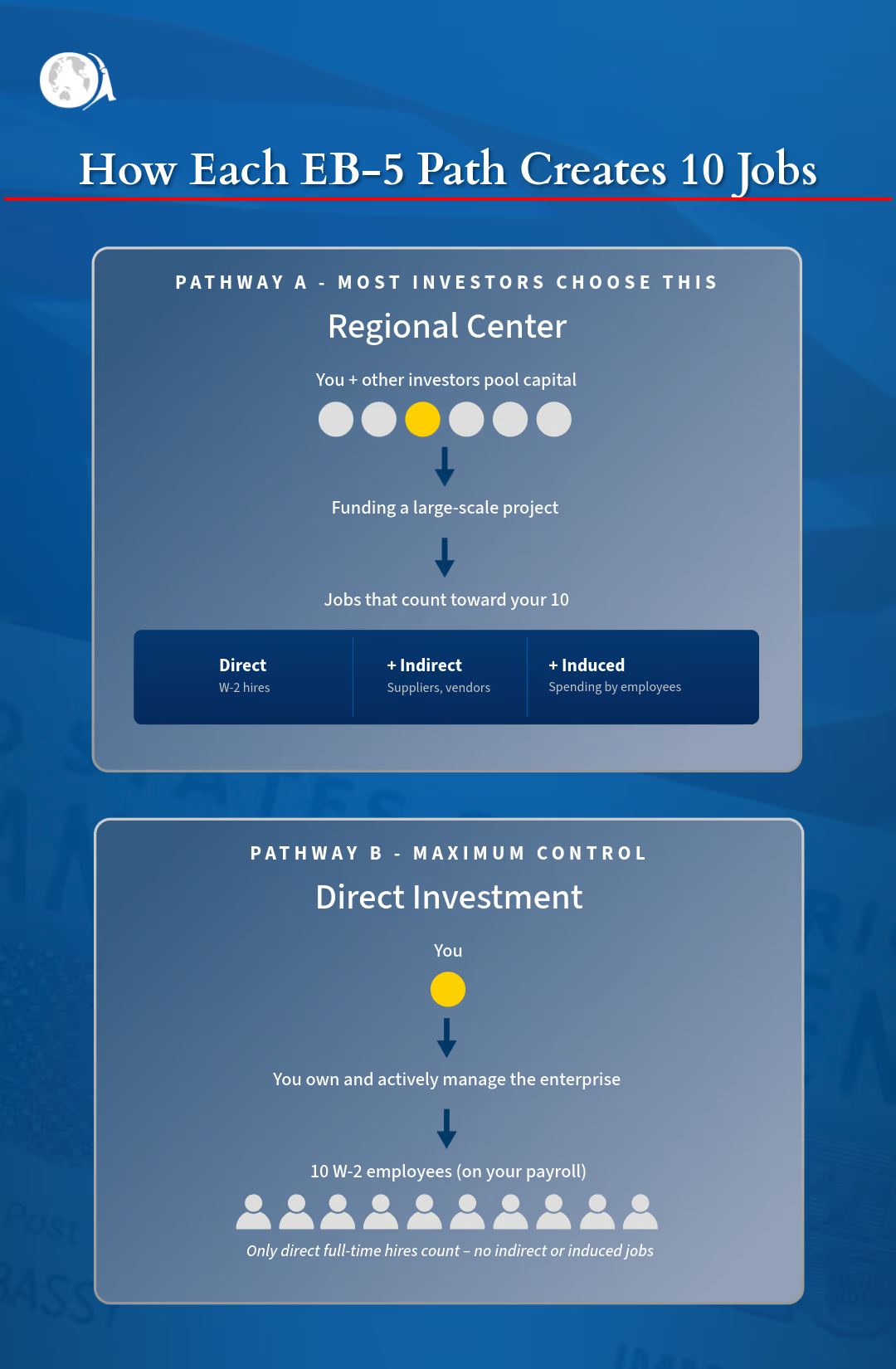
Regional centers act as intermediaries between investors and developers. They’re private, for-profit businesses approved by USCIS that charge commissions to handle project management and immigration compliance.
The job creation difference matters most. Regional centers let you count indirect jobs through economic modeling. Direct investment requires actual W-2 employees on payroll.
As of April 4, 2023, USCIS had approved 640 regional centers, but approval doesn’t guarantee project quality or your immigration success.
Direct investment offers more control over your capital. The tradeoff: you must actively manage the enterprise and directly employ 10 full-time U.S. workers. Most EB-5 investors choose regional centers because indirect job counting reduces operational burden.
Action Step: Request detailed fee schedules from any regional center before committing. Verify their I-526 approval track record with USCIS data — not marketing materials.
The I-526 Petition: Proving Your Investment Qualifies
Form I-526 (Immigrant Petition by Alien Entrepreneur) establishes your eligibility. USCIS must approve it before you can apply for an immigrant visa. Labor certification is not required for immigrant investors.
USCIS reviews three core areas: investment structure, job creation methodology, and lawful source of funds. You must demonstrate where every dollar came from through tax returns, bank statements, business sale records, and complete transaction history.
Your business plan must show exactly how your investment creates 10 permanent full-time positions within two years of receiving conditional residency.
Your capital must be fully committed to the commercial enterprise without any guarantee of return. If USCIS determines you’ve structured the investment to protect against loss, your petition fails.
After approval, your petition goes to the National Visa Center (NVC)/content/travel/en/us-visas/immigrate/national-visa-center.html). The NVC assigns a case number and instructs you to complete Form DS-261 when your priority date meets the most recent qualifying date.
Action Step: Gather complete financial documentation going back at least five years before consulting with an EB-5 attorney. Incomplete source-of-funds documentation is one of the most common reasons for I-526 delays.
Conditional Permanent Residency and the I-829 Petition
Once USCIS approves your I-526, you receive conditional permanent residency valid for two years. During this period, your investment must remain at risk, and you must create the required 10 jobs.
Conditional residents hold the same rights as permanent residents. You can live anywhere in the United States, work for any employer, and travel internationally.
File Form I-829 within the 90-day window before your conditional residency expires. USCIS reviews job creation evidence, proof your capital remained at risk, and business performance documentation.
Payroll records, tax documents, and employee verification forms serve as primary evidence. Approval converts your status to a standard 10-year green card, renewable indefinitely. Denial terminates your conditional residency immediately — you may face removal proceedings.
The Bottom Line: Mark your calendar for the 90-day filing window. Begin compiling job creation evidence and financial records at least six months before the deadline.
EB-5 Timeline: Realistic Processing Expectations by Stage
Your priority date — the date USCIS receives your I-526 petition — determines your place in line if you’re from a backlogged country.

Visa availability creates the biggest timeline variable. Most countries have immediate availability. But nationals from China, India, and Vietnam face multi-year backlogs. The State Department publishes a monthly visa bulletin showing current wait times by country.
Consular processing or adjustment of status adds additional months after both I-526 approval and visa availability.
Conditional residency lasts exactly two years from green card issuance. This period is fixed regardless of processing delays.
Certain immigrant investors can retain the priority date of a previously approved EB-5 petition when filing a new one — a critical safeguard if a project fails and you need to start over.
Action Step: Check the State Department's monthly visa bulletin at travel.state.gov to see current wait times for your country of birth.
Family Member Eligibility and Aging Out Risks
Your spouse and unmarried children under 21 receive derivative green cards when your EB-5 petition is approved. They gain the same conditional permanent residency without filing separate petitions.
The risk emerges during processing delays. Children who turn 21 before your petition is fully processed may “age out” and lose derivative eligibility.
The Child Status Protection Act (CSPA) provides limited protection by subtracting I-526 processing time from your child’s biological age at approval. If your child’s CSPA age still exceeds 21 when a visa becomes available, they age out despite the protection.
In practice, families from China, India, and Vietnam face the highest aging-out risk due to visa backlogs extending beyond a decade. Aged-out children must pursue separate pathways, most commonly the F2B category with wait times exceeding five years.
EB-5 vs. Other Investor Visa Options: E-2 and EB-1C
The E-2 treaty investor visa requires no minimum investment amount but grants only temporary status, requiring renewal every two to five years. It excludes Chinese and Indian nationals, who represent the majority of EB-5 applicants.
The EB-1C multinational manager visa demands an existing relationship between a foreign company and a U.S. subsidiary but sets no specific investment threshold. Unlike EB-5, it leads directly to permanent residency without a conditional period.
EB-5 offers two distinct advantages: no treaty country requirement and a clear path to permanent residency for investors from any nation. The tradeoff is higher capital ($800,000–$1,050,000), longer timelines, and capital that must remain at risk.
Frequently Asked Questions
How long does it take to get an EB-5 green card?
After USCIS approves your I-526 petition, you receive conditional permanent residency for two years. During this period, you must create the required 10 jobs and keep your investment at risk. After the conditional period, you file Form I-829 to receive your 10-year green card. Processing times for both petitions add months or years, depending on your country of origin and USCIS workload.
What is the minimum investment for an EB-5 visa?
The minimum is $800,000 for projects in targeted employment areas or infrastructure projects, and $1,050,000 for standard investments. These amounts took effect March 15, 2022, under the EB-5 Reform and Integrity Act. You must invest without borrowing, and your capital must remain at risk throughout the conditional residency period.
What happens if my EB-5 investment fails before I get my green card?
You risk denial of your I-829 petition and loss of permanent residency. USCIS requires proof that you sustained the investment and created the required 10 jobs. A complete business failure that eliminates jobs typically results in an I-829 denial. This is why due diligence on regional centers and projects is critical before investing.
Can my children get green cards through my EB-5 investment?
Your spouse and unmarried children under 21 apply for lawful permanent residence together when you file your I-526 petition. The critical factor is your child’s age — if they turn 21 during processing, they may age out unless protected by the Child Status Protection Act.
What is the difference between conditional and permanent residency in EB-5?
Conditional residency is a two-year status requiring you to prove job creation and sustained investment. You hold full work authorization and can live anywhere in the U.S. After two years, you file Form I-829 demonstrating 10 full-time jobs and at-risk investment. Approval grants a 10-year green card renewable indefinitely.
Should I invest through a regional center or make a direct EB-5 investment?
The vast majority of EB-5 investors choose regional centers because they allow indirect job creation and typically invest in TEAs at the lower $800,000 threshold. Direct investments require you to create 10 jobs through your own business. Direct investments give you more control but demand active management.
What source of funds documentation does USCIS require for EB-5?
USCIS requires comprehensive documentation proving your investment capital came from lawful sources. You must trace funds from the origin through any transfers to the final investment. Acceptable documentation includes tax returns, business ownership records, property sale agreements, employment contracts, inheritance documents, and bank statements. Expect to provide years of financial records, translated into English with certified translations where applicable.
What to Do Next
You’ve seen the requirements. Now map them to your situation.
This week:
- Check the current visa bulletin at travel.state.gov for your country of origin — if you’re from China, Vietnam, or India, backlogs change monthly.
- Calculate whether your children will turn 21 during the estimated processing timeline.
- Gather preliminary source of funds documentation to assess gaps — the lawful source requirement trips up more applicants than the investment amount itself.
This month:
- Consult with an immigration attorney experienced in EB-5 cases to evaluate your eligibility and timeline.
- If considering regional centers, request I-526 and I-829 success rates for specific projects — not all 640 approved regional centers have equal track records, and failed projects mean lost investment plus no green card.
Ongoing:
- Monitor USCIS processing times at uscis.gov — speeds fluctuate based on agency staffing and policy changes.
- Review monthly visa bulletin updates if you’re from a backlogged country.
This article is provided for informational purposes only, and does not constitute legal advice nor does it create an attorney–client relationship with Oltarsh & Associates, P.C. or any of its lawyers, employees and/or agents. Laws and policies change, and information here may not reflect the most current legal developments. You can contact us about your specific situation.



 English
  Español