

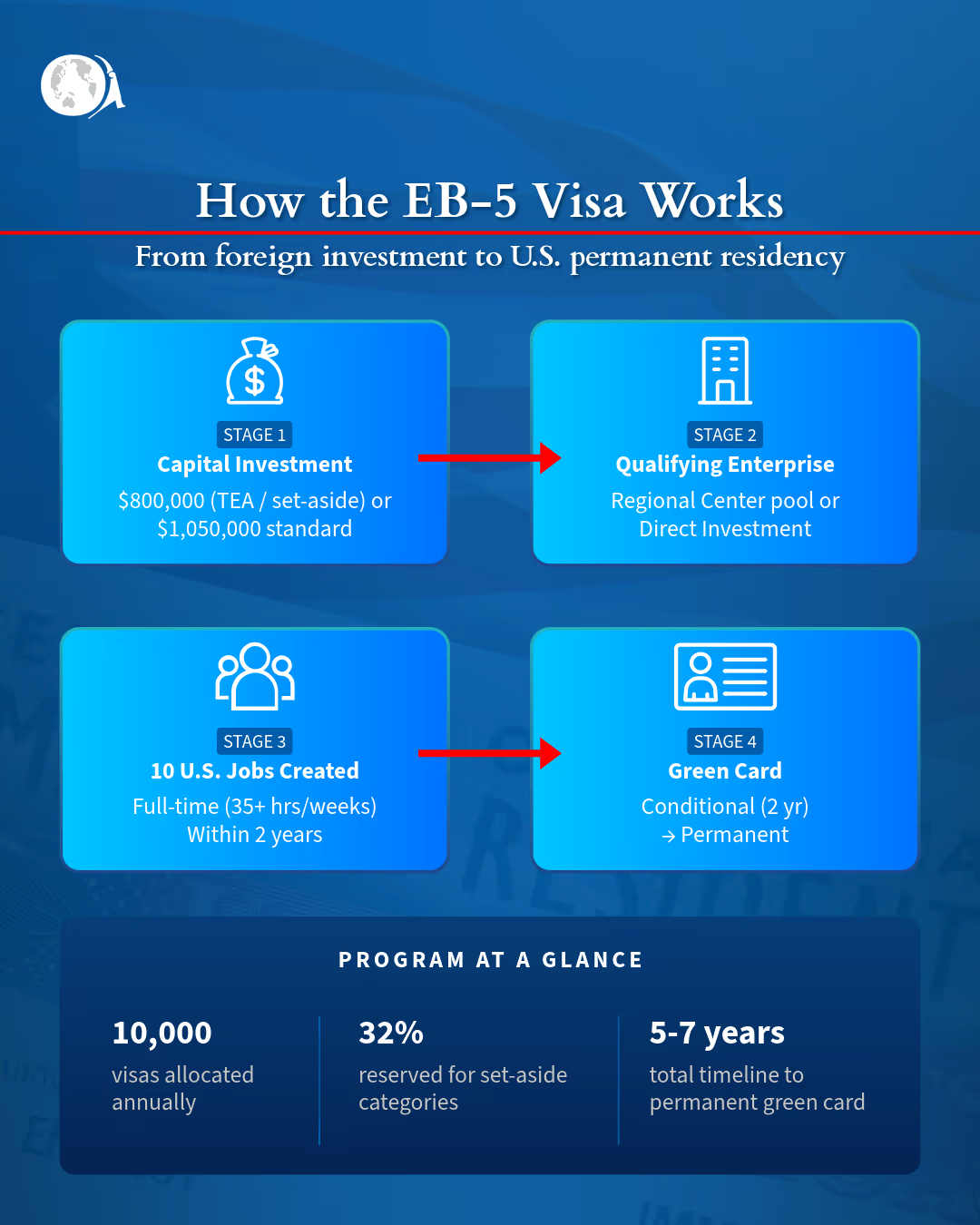
The EB-5 visa lets foreign nationals secure U.S. permanent residency by investing capital and creating American jobs. You invest a minimum amount in a qualifying business, that business creates at least 10 full-time positions for U.S. workers, and USCIS grants you a green card.
The 2022 Reform and Integrity Act restructured the entire program. Minimum investment amounts changed. Visa set-asides now prioritize rural and high-unemployment areas. Regional center oversight tightened after years of fraud scandals.
If you’re considering the EB-5 pathway, you’re navigating a program where investment amounts range from $800,000 to $1,050,000, processing times stretch years, and denial rates at the I-526E stage run between 20% and 30% based on historical USCIS data.
The stakes are clear: structure your investment correctly and you gain permanent U.S. residency for yourself and your immediate family. Miss a documentation requirement or choose a non-compliant regional center, and you risk both your immigration status and your capital.
This guide walks through every decision point in the EB-5 investor visa process.
The EB-5 visa is the fifth employment-based preference category in U.S. immigration law, created by Congress in 1990 to stimulate economic growth through foreign capital investment. It grants permanent residency (a green card) to foreign nationals who invest in U.S. businesses that create American jobs.
Unlike EB-1, EB-2, or EB-3 visas, the EB-5 visa does not require employer sponsorship or labor certification. You are both the petitioner and the job creator. Your investment funds the enterprise that generates the required employment.
Congress allocates 10,000 EB-5 visas annually. This cap includes derivatives, meaning your spouse and unmarried children under 21 count against the total. When demand exceeds supply, particularly from countries like China, Vietnam, and India, processing backlogs can stretch for years.
The program offers two distinct pathways. Regional Center investments allow you to pool capital with other investors in USCIS-designated projects; typically, real estate developments or infrastructure initiatives managed by third-party sponsors. Direct investments require you to establish or invest in a business you actively manage, creating jobs through your own enterprise.
The 2022 Reform and Integrity Act introduced three set-aside categories with reserved visa allocations: rural projects (20% of annual visas), high-unemployment area projects (10%), and infrastructure projects (2%). These categories receive priority processing, addressing one of the program’s most persistent problems — unpredictable wait times.
In practice, the set-asides matter more than the investment amount. A rural project investor may receive conditional green card approval within 12–18 months. An investor in a standard regional center project from a backlogged country could wait significantly longer for the same outcome.
The job creation requirement remains constant across both pathways: your investment must create or preserve at least 10 full-time jobs for U.S. workers within two years of receiving conditional permanent residency. Regional center investments count direct, indirect, and induced jobs (calculated through economic models). Direct investments count only W-2 employees hired by your business.
You receive conditional permanent residency first (a two-year green card). Before that expires, you file Form I-829 to remove conditions, proving your investment remained at risk and created the required jobs. Only after USCIS approves this petition do you receive a permanent, unrestricted green card.
The EB-5 visa doesn’t require you to live near your investment or work in the business for regional center projects. You can reside anywhere in the U.S. once you receive conditional residency, though direct investment projects typically require more hands-on involvement to demonstrate job creation.
The EB-5 visa program requires a minimum investment of $1,050,000 in a new commercial enterprise, or $800,000 if the business is located in a Targeted Employment Area (TEA). These amounts, set by the 2022 EB-5 Reform and Integrity Act, remain fixed until January 1, 2027, when USCIS will adjust them for inflation using the Consumer Price Index.
The $800,000 threshold applies to investments in rural areas or regions where unemployment exceeds 150% of the national average. Projects in these categories, along with infrastructure investments, receive priority processing under the EB-5 Reform and Integrity Act of 2022. They also access 32% of annual visa allocations set aside specifically for them.
A rural area under EB-5 is any location outside a metropolitan statistical area (MSA) and outside the outer boundary of any city or town with a population of 20,000 or more, based on the most recent decennial census. A high-unemployment area is typically demonstrated by combining contiguous census tracts whose weighted-average unemployment rate is at least 150% of the national average per Bureau of Labor Statistics data. The TEA designation must be issued by an authorized government agency and must be valid on the date Form I-526E is filed — a designation that lapses before filing does not count, and supporting evidence (census data or BLS data) must accompany the petition.
Your capital cannot sit in a guaranteed account or earn fixed returns. The EB-5 statute requires that your investment be subject to potential loss based on the commercial enterprise’s actual performance.
Passive loans with guaranteed repayment don’t qualify. Neither do escrow arrangements that protect your principal regardless of project outcomes. USCIS examines whether your funds are genuinely deployed in business operations, purchasing equipment, hiring employees, leasing facilities, where success determines returns.
Most investors choose Regional Center projects that pool capital for large-scale developments. Even in these structures, your investment must remain at risk throughout the conditional residency period, typically until you file to remove conditions on your green card.
| Investment Type | Standard Amount | TEA Amount | At-Risk Requirement |
|---|---|---|---|
| Direct Enterprise | $1,050,000 | $800,000 | Capital deployed in operations with no guaranteed return |
| Regional Center Project | $1,050,000 | $800,000 | Pooled investment subject to project performance |
| Set-Aside Categories | $1,050,000 | $800,000 | Same risk requirement plus priority processing for rural, high-unemployment, and infrastructure projects |
USCIS requires comprehensive documentation proving your investment capital came from lawful sources. This isn’t a formality — it’s often the most time-intensive part of EB-5 preparation.
You must trace the origin of every dollar through tax returns, business records, property sale documents, inheritance records, or gift letters. If funds came from selling a business, USCIS wants contracts, corporate tax filings, and evidence of how you originally acquired that business. If your spouse is contributing, you’ll document their income history as well.
The agency scrutinizes whether the money passed through legitimate channels. Bank statements alone rarely suffice. You need the underlying documents that show how those deposits occurred: employment contracts for salary, invoices for business income, and deeds for property sales.
In our work with EB-5 investor visa applicants, we’ve seen cases delayed for months because investors couldn’t produce sufficient documentation for a single $50,000 wire transfer from a family member. The standard is exhaustive by design.
Gift funds are permissible, but the donor must prove their source of funds with the same rigor. A gift letter stating “my father gave me $800,000” triggers a full financial review of your father’s assets and income history.
Action Step: Gather five years of tax returns, business ownership documents, and records for any asset sales or inheritances exceeding $50,000. Start this process before selecting an investment project — source of funds preparation typically takes three to six months.
You have two paths to EB-5 permanent residency: invest through a regional center or make a direct investment. The choice determines how much control you have, which jobs count toward your requirement, and how long your capital stays locked up.

Regional centers are USCIS-designatedentities that pool capital from multiple EB-5 investors to fund large-scale projects. Typically real estate developments, manufacturing facilities, or infrastructure initiatives. You invest alongside other foreign nationals, and the regional center manages the project.
The critical advantage: regional center investments allow indirect job creation counting. Construction jobs, supplier jobs, and induced economic activity all qualify toward your 10-job requirement. An economist calculates these jobs using USCIS-approved methodologies, often making it easier to meet the threshold without direct hiring.
Direct investments require you to actively manage or participate in the day-to-day operations of the new commercial enterprise. You must create 10 full-time jobs directly within your business — W-2 employees on your payroll, working at least 35 hours per week. This path offers complete control over your investment and business decisions. But you’re responsible for hiring, managing, and maintaining those 10 positions throughout the conditional residency period.
| Factor | Regional Center | Direct Investment |
|---|---|---|
| Job Creation | Indirect jobs count (construction, suppliers, economic multiplier) | Only direct W-2 employees count |
| Management Role | Passive investor (no operational duties required) | Active management or policy-making role required |
| Administrative Fees | 4–7% of investment amount typical | No pooling fees (but legal/consulting costs apply) |
| Capital Lock-Up | 5–7 years common | Flexible — exit when jobs maintained and I-829 approved |
| Project Selection | Choose from regional center offerings | Create or acquire your own business |
The table above captures the structural trade-offs. Beyond those factors, the 2022 Reform and Integrity Act introduced enhanced oversight for regional centers. All existing centers had to recertify with USCIS under stricter standards. New requirements mandate annual compliance reporting, site visits, and detailed financial disclosures.
As of 2024, approximately 600 regional centers have received re-certification, down from over 800 before the reform. The consolidation removed non-compliant operators but also reduced your pool of investment options.
In our work with EB-5 investors, the decision often comes down to two factors: your willingness to relocate and manage a U.S. business, and your risk tolerance for direct operational involvement. Regional centers suit investors who want a passive role. Direct investments work better if you’re moving to the U.S., have industry expertise, and want control over your capital deployment.
The Bottom Line: Regional centers offer easier job creation through indirect counting and passive investment, but charge fees and lock up capital longer. Direct investments give you control and flexibility but require active management and direct hiring of 10 employees.
Every EB-5 investor must create or preserve 10 full-time jobs for U.S. workers. This requirement applies whether you invest through a regional center or make a direct investment. The difference is in which types of jobs count toward your total.
Full-time employment means at least 35 hours per week. You cannot combine two part-time positions to meet the requirement, even if their combined hours exceed 35.
The jobs must be filled by U.S. citizens, lawful permanent residents, or other immigrants authorized to work in the United States. Positions held by the investor, their spouse, or their children do not count toward the 10-job requirement. Independent contractors and consultants generally don’t qualify unless they work exclusively for your enterprise and meet the full-time hour threshold.
For direct investments, jobs must be created within your new commercial enterprise (NCE) or a job-creating entity (JCE) that your NCE owns. These are W-2 employees on your company’s payroll.
USCIS requires documentation like quarterly tax statements (Form 941), payroll records, and I-9 employment eligibility verification forms. In our work with direct EB-5 investors, we’ve seen cases delayed six months or more when clients couldn’t produce clean payroll documentation showing sustained employment.
The jobs must exist when you file Form I-829 to remove conditions on your permanent residence (typically 21 to 24 months after you receive conditional residency).
Regional center projects use economic impact models to calculate indirect and induced jobs. These models — RIMS II from the Bureau of Economic Analysis or IMPLAN from IMPLAN Group — estimate employment generated through supply chain activity (indirect jobs) and consumer spending by direct employees (induced jobs).
A hotel development might directly employ 50 people but generate 200 additional jobs through construction suppliers, food vendors, and local spending by hotel staff. All 250 jobs can count toward investor requirements in a regional center structure.
USCIS reviews the economic impact study’s methodology and assumptions. The study must be prepared by an economist using current data for the project’s geographic area and industry sector.
Job creation must be sustained for at least two years after you receive conditional permanent residence. USCIS verifies this when you file Form I-829 to remove conditions and obtain your permanent green card.
You’ll submit evidence that all 10 jobs existed during the required period. For direct investments, this means payroll records, tax documents, and organizational charts. For regional center investments, the project developer provides documentation of total job creation across all investors.
Failure to maintain the required jobs is one of the most common reasons for I-829 denial. According to USCIS data, approximately 10% of I-829 petitions are denied, with insufficient job creation evidence cited as a leading factor.
Action Step: Request sample job creation documentation from your immigration attorney or regional center before investing. Review what evidence you’ll need to collect from day one to prove sustained employment at the I-829 stage.
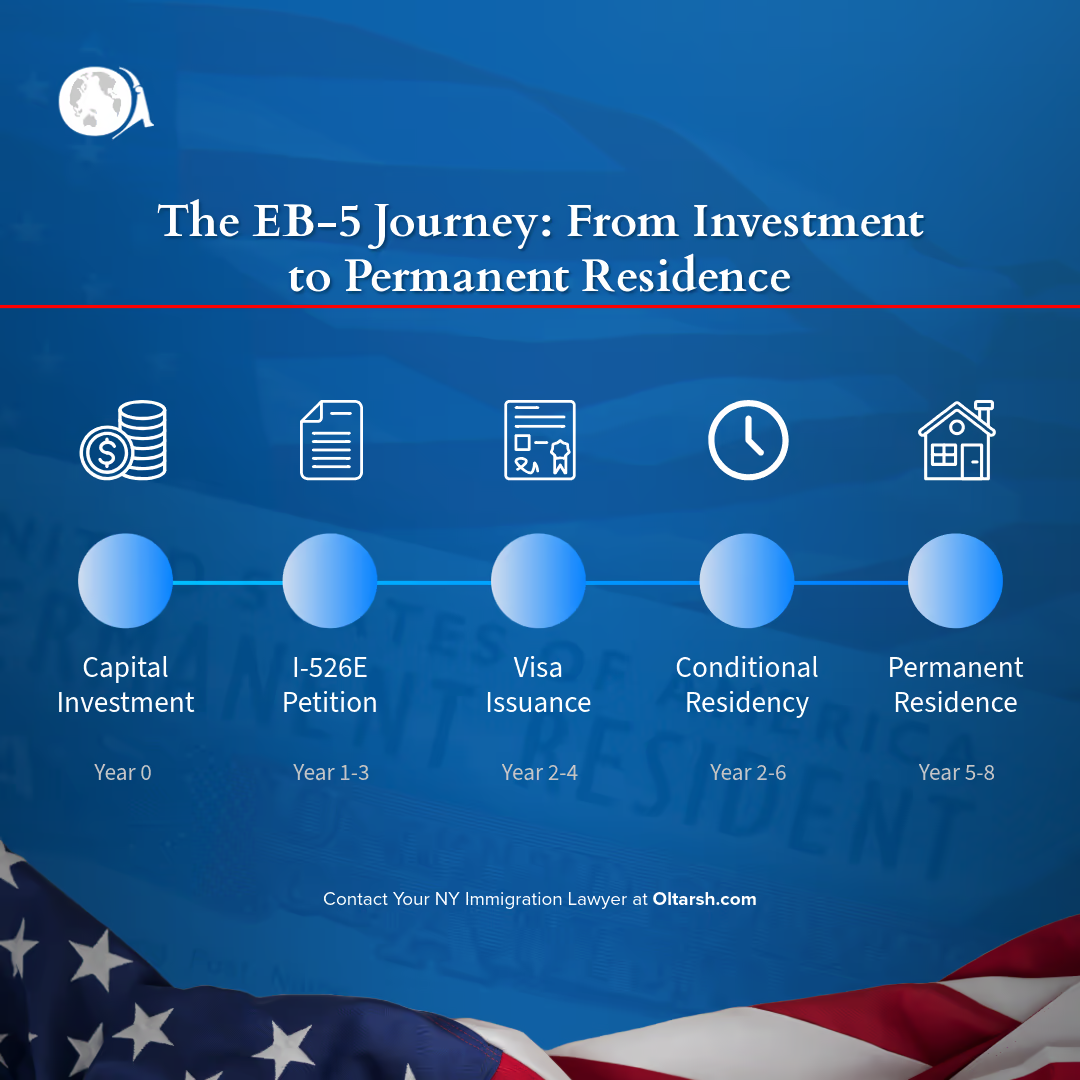
The EB-5 visa process takes five to seven years from initial investment to unconditional permanent residence. You’ll move through four distinct stages, each with its own USCIS review, documentation requirements, and waiting periods.
Understanding this timeline matters because your capital remains at risk throughout. Your family’s immigration status depends on meeting every deadline.
Your immigration attorney files Form I-526E (Immigrant Petition by Standalone Investor) with USCIS. This petition proves three things: your investment structure complies with EB-5 regulations, your funds came from lawful sources, and your chosen enterprise has a credible job creation plan.
USCIS currently processes I-526E petitions in 30–40 months for standard applications. If you invest in a set-aside category — rural, high-unemployment, or infrastructure projects — expect 12–18 months instead.
The agency scrutinizes your source of funds documentation during this stage. You’ll need bank statements, tax returns, business records, and sworn affidavits tracing every dollar back to its origin.
Once USCIS approves your I-526E, you wait for a visa number to become available. The EB-5 investor visa program allocates 10,000 visas annually, with per-country limits that create backlogs for investors from mainland China, Vietnam, and India.
When your priority date becomes current, you choose between two paths based on your location.
Investors already in the U.S. file Form I-485 (Application to Register Permanent Residence or Adjust Status). This allows you to remain in the country while USCIS processes your green card application.
Investors abroad attend a visa interview at a U.S. embassy or consulate. After approval, you receive an immigrant visa and must enter the United States within six months.
You receive a conditional green card valid for two years. This card grants you, your spouse, and unmarried children under 21 the same rights as permanent residents — you can live, work, and study anywhere in the United States.
The “conditional” designation means USCIS hasn’t yet verified that your investment created the required jobs. Your capital must remain at risk throughout this period.
You file Form I-829 during the 90-day window before your conditional green card expires. This petition proves your investment remained at risk and created (or will create) 10 full-time jobs for U.S. workers.
USCIS currently takes 36–48 months to process I-829 petitions. If you file on time, you receive a 48-month extension of your conditional status while the agency reviews your case.
The I-829 approval converts your conditional green card to a permanent one with no expiration conditions. You’re now a lawful permanent resident eligible for citizenship after five years.
The table below summarizes each stage and its current processing window.
| Stage | Form | What USCIS Reviews | Current Processing Time |
|---|---|---|---|
| 1. Petition | I-526E | Investment structure, fund sources, job creation plan | 30–40 months (standard); 12–18 months (set-aside) |
| 2. Status Change | I-485 or Consular | Background check, admissibility | 6–12 months |
| 3. Conditional Residence | – | (Two-year validity period) | 24 months |
| 4. Remove Conditions | I-829 | Job creation proof, sustained capital investment | 36–48 months |
The Bottom Line: Plan for your capital to remain at risk for six to eight years — two years of conditional residence plus three to four years of I-829 processing.
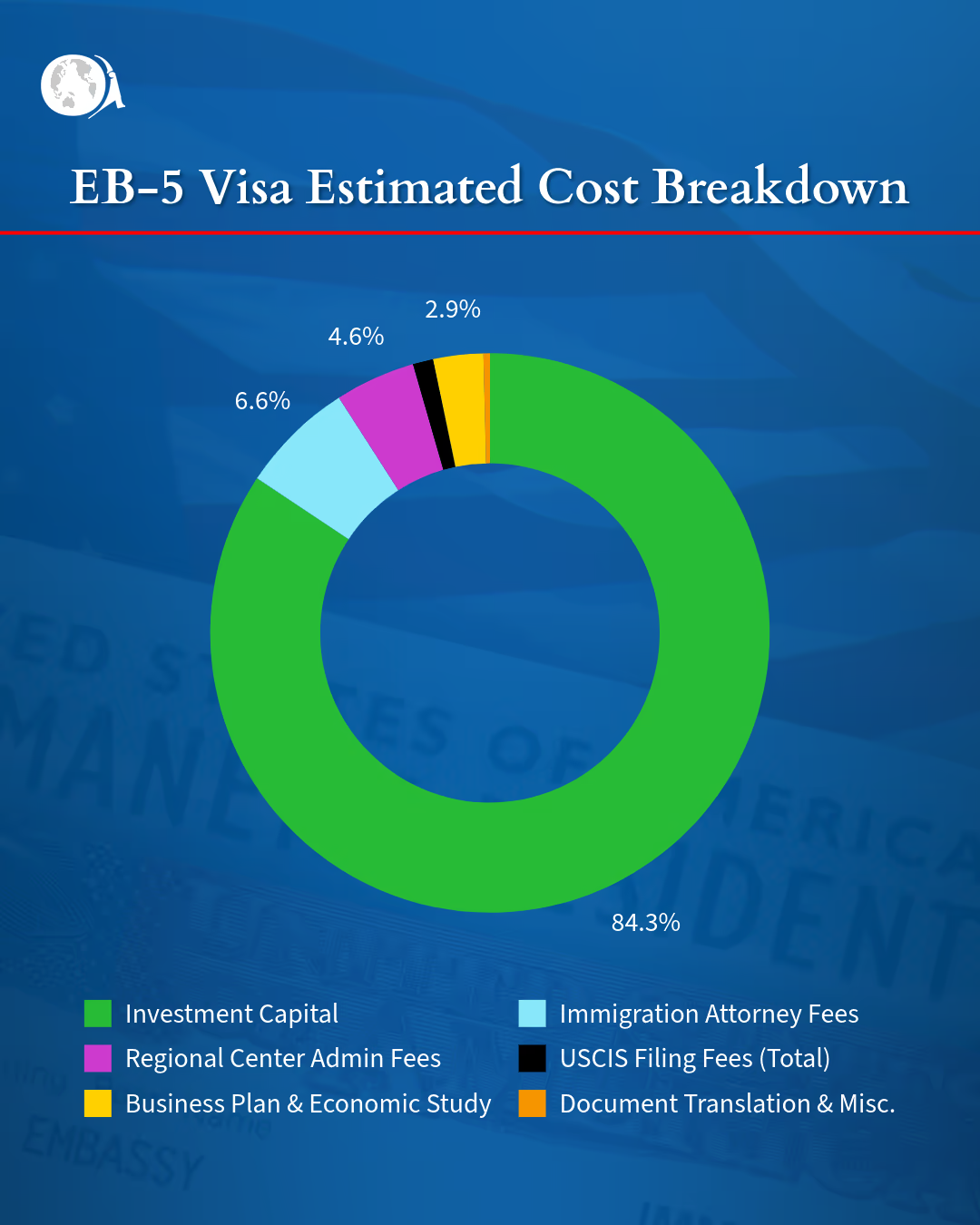
The total cost of obtaining an EB-5 visa ranges from $900,000 to $1,200,000. That includes investment capital, professional fees, and government filing costs. The investment itself — $800,000 or $1,050,000, depending on project location — is capital you place at risk, not a fee you pay for processing.
Legal fees, regional center administrative costs, and USCIS filing fees typically add $100,000–$150,000 to your total outlay before you receive conditional residency.
Your minimum investment is $800,000 for projects in Targeted Employment Areas or designated set-aside categories. Standard projects in non-TEA locations require $1,050,000.
This capital must remain at risk throughout conditional residency. You cannot structure the investment as a guaranteed loan. Regional center investments typically return capital within five to seven years after I-829 approval. Direct investments often require longer holding periods because you must demonstrate the business remains viable through the removal of conditions process.
| Expense Category | Typical Range | What It Covers |
|---|---|---|
| Immigration attorney fees | $50,000–$75,000 | I-526E preparation, I-485 filing, I-829 petition, case monitoring |
| Regional center admin fees | $32,000–$56,000 | Due diligence, project management, investor relations (4–7% of investment) |
| Business plan preparation | $5,000–$15,000 | Comprehensive plan for USCIS submission (direct investments) |
| Economic impact study | $10,000–$25,000 | Job creation analysis (required for direct investments) |
| Document translation/certification | $2,000–$5,000 | Certified translations of foreign financial records |
Legal fees vary based on case complexity and whether you’re adjusting status in the U.S. or processing through consular channels abroad. Firms typically charge flat fees covering representation through I-829 approval, though some bill hourly for appeals or complex source-of-funds documentation.
Regional center administrative fees are usually deducted from your investment at closing. An $800,000 investment requires $832,000–$856,000 in total capital when you account for these costs.
Government filing fees total approximately $11,160 for a single applicant. The breakdown: $3,675 for Form I-526E, $1,440 per person for Form I-485 (adjustment of status), $3,750 for Form I-829 (removal of conditions), and $85–$90 per person for biometrics. (VERIFY: fees are updated periodically)
Family members adjusting status with you each pay the $1,440 I-485 fee plus biometrics. A family of four typically pays $15,600–$16,000 in total USCIS fees across all petition stages.
Opportunity cost represents your largest hidden expense. Your capital remains locked for five to eight years. At a conservative 5% annual return, $800,000 generates $200,000–$320,000 in foregone earnings over this period.
Tax preparation becomes more complex once you gain U.S. residency. Specialized accounting for worldwide income reporting typically costs $3,000–$8,000 annually for high-net-worth individuals with international holdings.
Travel expenses add up if you’re processing from abroad. Expect $5,000–$15,000 for multiple trips to the U.S. for biometrics appointments, interviews, and initial entry after visa approval.
Regional centers are USCIS-designated entities that pool capital from multiple EB-5 investors into job-creating projects. Typically, real estate developments, infrastructure builds, or manufacturing operations. They allow you to count indirect and induced jobs toward your 10-job requirement, not just direct hires.
USCIS maintains a public database of all active regional centers. Designation means the entity has filed administrative paperwork, not that USCIS endorses any specific project it sponsors.
Regional center investments account for the vast majority of all EB-5 filings. Documenting indirect job creation through economic models is far easier than hiring and retaining 10 full-time employees yourself. For investors who want passive involvement and proven job-creation methodologies, regional centers offer a more predictable path.
The 2022 Reform and Integrity Act tightened oversight significantly. Regional centers must now re-certify with USCIS, maintain reserve funds to cover operational costs if projects fail, and submit annual compliance reports detailing capital deployment and job creation. Centers that fail to meet these standards lose their designation — and their investors lose their pathway to permanent residency.
Due diligence on the regional center’s track record matters more than the project’s marketing materials. Look for centers with multiple I-526 approvals, transparent capital structures, and a history of returning investor capital within the projected timeline.
In our work with EB-5 clients, we’ve seen investors focus on project renderings and location while ignoring the regional center’s compliance history. That’s backward. The center’s administrative competence determines whether USCIS approves your petition, regardless of how attractive the underlying development looks.
For a complete evaluation framework, see our dedicated guide to evaluating EB-5 regional center projects. It covers how to verify job creation models, assess capital structure risk, and identify red flags in offering documents.
USCIS denies approximately 20–30% of EB-5 petitions at the I-526E stage, based on historical approval data. Most denials stem from five recurring documentation failures.
USCIS requires a complete paper trail showing how you lawfully earned or acquired every dollar of your investment capital. Gaps in your financial history (even small ones) trigger Requests for Evidence or outright denials.
You must document funds through tax returns, business ownership records, property sale agreements, gift letters with donor financials, and bank statements showing money movement. If you sold a business, USCIS wants to see how you originally acquired it and how it generated the sale proceeds.
Start gathering financial documents at least 12 months before filing.
The EB-5 investor visa statute requires your capital be placed “at risk” for the purpose of generating a return. Structured repayment guarantees, fixed-rate returns, or collateral arrangements that protect your principal disqualify the investment.
USCIS scrutinizes loan agreements and subscription documents for language suggesting guaranteed returns. If the regional center promises to buy back your investment at a predetermined price, your petition fails the at-risk requirement. A legitimate EB-5 investment functions like equity, not debt. Review all investment documents with an immigration attorney before signing.
I-829 petitions, filed to remove conditions on your green card, are denied when you cannot prove the required 10 jobs were created and maintained throughout your conditional residency period. USCIS requires payroll records, tax filings (Form 941), and business revenue documentation.
According to USCIS data, approximately 10% of I-829 petitions are denied, with job creation documentation failures cited as a leading factor.
Direct investors face the highest risk. If your business fails or reduces headcount before you file Form I-829, you lose your immigration benefit even though your capital is gone. Regional center investors have some protection through indirect job calculations, but the underlying project must still perform as the economic report predicted.
For direct investments, work with an economist to document job creation in real time — not retroactively.
USCIS denies petitions when the capital never reaches the specific new commercial enterprise (NCE) described in your I-526E filing. Denials also occur when funds are diverted to purposes unrelated to the approved business plan.
The NCE must be a for-profit entity formed after November 29, 1990, or a pre-existing business restructured or expanded such that a new commercial enterprise resulted. Simply purchasing an existing business without substantial changes doesn’t qualify.
In regional center investments, verify that your capital flows from your account to the NCE to the job-creating entity (JCE) with clear documentation at each step. USCIS wants subscription agreements, capital call notices, wire transfer records, and NCE bank statements showing deployment. Capital must be committed to the enterprise, not warehoused in a holding account.
If your regional center loses its USCIS designation before you obtain conditional permanent residence, your I-526E petition is at risk of denial. Between 2021 and 2022, USCIS terminated hundreds of regional center designations due to the program’s temporary lapse and subsequent reauthorization requirements.
Investors with pending I-526E petitions when a center is terminated face a difficult choice: find a new qualifying project and re-file, or abandon the petition and lose filing fees.
Due diligence on regional center stability matters as much as project economics. Check whether the center has maintained a continuous USCIS designation, review its compliance history, and confirm it filed for reauthorization under the EB-5 Reform and Integrity Act of 2022. USCIS publishes a list of currently designated regional centers on its website — verify your center appears on that list before investing.
Your spouse and unmarried children under 21 can receive green cards through your EB-5 investment at no additional capital requirement. They qualify as derivative beneficiaries — family members included on your I-526E petition who receive the same immigration benefits you do.
When USCIS approves your petition, your derivatives receive conditional green cards on the same timeline as you. They don’t need to meet the investment or job creation requirements independently. When you file Form I-829 to remove conditions after two years, you must include all family members who received conditional residence. If they’re excluded from the I-829, they lose their green cards.
The critical risk for families is age-out — when a child turns 21 during petition processing and no longer qualifies as a derivative. In our work with investor families, we’ve seen children lose eligibility months before approval because parents didn’t account for USCIS processing delays.
The Child Status Protection Act (CSPA) provides limited protection by freezing a child’s age for immigration purposes under specific circumstances. CSPA doesn’t stop biological aging — it creates a legal calculation that can keep a 21-year-old classified as a “child” for visa purposes.
The CSPA calculation: subtract the number of days your I-526E petition was pending from your child’s age on the date USCIS approved it. If the result is under 21 years, your child remains eligible as a derivative beneficiary.
For example, if your child was 20 years and eight months old when USCIS approved your petition, and processing took 14 months, the CSPA age would be 19 years and six months. That falls safely under the 21-year threshold.
CSPA protection only applies if your child was under 21 when you filed the I-526E petition. If they were already 21 or older at filing, CSPA cannot help.
If your child ages out despite CSPA protection, they lose derivative status. They cannot convert to another visa category through your EB-5 petition.
Instead, they must either qualify independently through their own employment or education visa, or wait until they become a U.S. citizen and petition them as an adult, unmarried child. That process can add seven to 10 years.
The timing risk is highest for children between the ages of 16 and 20 at the time of filing. If your child falls in this range, calculate their CSPA age using current I-526E processing times before committing to the EB-5 investor visa pathway.
Derivatives also face the same conditional residence requirements as the principal investor. They must maintain their status, avoid criminal issues, and remain in the United States or demonstrate intent to reside here when they file I-829. A derivative who abandons U.S. residence during the conditional period cannot be included in the removal of conditions.
The EB-5 visa isn’t your only path to U.S. residency through business investment. Three other visa categories, E-2, L-1, and EB-1C, offer alternatives with different investment thresholds, processing times, and outcomes.
The critical difference: only EB-5 and EB-1C lead directly to a green card. E-2 and L-1 are temporary visas that require renewal and don’t guarantee permanent residence.
| Feature | EB-5 | E-2 Treaty Investor | L-1 Intracompany Transfer | EB-1C Multinational Executive |
|---|---|---|---|---|
| Investment Required | $800,000–$1,050,000 | No statutory minimum (typically $100,000–$200,000) | No investment required | No investment required |
| Green Card | Direct path | No direct path to permanent residence | Leads to EB-1C green card | Direct path |
| Processing Time | 5–7 years total | 2–4 months | 2–4 months for visa; 12–18 months for EB-1C | 12–18 months |
| Visa Duration | Permanent (conditional initially) | 2–5 years, renewable indefinitely | L-1A: 7 years max; L-1B: 5 years max | Permanent |
| Employer Sponsorship | Not required | Not required | Required (your own company) | Required (your own company) |
| Treaty Country | Not required | Must be from treaty country | Not required | Not required |
| Family Included | Yes, at no additional investment | Yes | Yes | Yes |
The table captures the structural differences. Here’s how each option works in practice.
The E-2 visa requires a “substantial” investment. Typically $100,000 to $200,000. You must be a citizen of a treaty country. Over 80 countries qualify, including Canada, Japan, and the UK, but not China or India.
The visa grants two to five years of status, renewable indefinitely as long as your business operates. Your spouse can obtain work authorization. But E-2 is temporary with no direct conversion to a green card.
The L-1 visa allows multinational companies to transfer executives and managers (L-1A) or specialized knowledge employees (L-1B) from a foreign office to a U.S. entity. No capital investment needed. You must have worked for the foreign entity for at least one continuous year in the past three years.
L-1A holders can work in the U.S. for up to seven years and apply for an EB-1C green card. A path that takes 12–18 months, significantly faster than the EB-5 visa. The catch: you need an existing business relationship between foreign and U.S. companies, and the US company must be viable. The role must be genuinely managerial or executive. There is no path to permanent residence for L-1B employees unless they become managerial or executive; those cases face heightened scrutiny.
The EB-1C grants a green card to executives and managers transferred from a foreign company to a U.S. affiliate. Processing typically takes 12–18 months — roughly one-third the time of the EB-5 visa.
But EB-1C has rigid requirements. You must have worked abroad in a managerial or executive capacity for at least one year within the past three years. The U.S. company must have operated for at least one year. If you’re a hands-on operator running a small business, you likely won’t qualify.
The EB-5 visa offers three advantages that no other option provides: no employer sponsorship requirement, no treaty country restriction, and no need for prior foreign employment.
If you’re from China, India, or another non-treaty country, the EB-5 visa may be your only investment-based path. If you don’t have an existing multinational business, L-1 and EB-1C aren’t available.
The trade-offs are clear: higher capital ($800,000 vs. $100,000 for E-2), longer processing (five to seven years vs. 12–18 months for EB-1C), and investment risk throughout the conditional residency period.
The Bottom Line: If you have an existing multinational business and qualify for L-1/EB-1C, that's typically the faster, lower-risk path. If you lack foreign employment history or aren't from a treaty country, the EB-5 visa may be your only option for investment-based permanent residence.
Oltarsh & Associates has guided EB-5 investors through three decades of program evolution in New York City. We’ve navigated clients through every major reform since the category’s expansion — including the 2022 EB-5 Reform and Integrity Act that restructured set-aside categories and regional center oversight.

Our practice focuses on the two areas where most EB-5 cases fail: source-of-funds documentation and regional center vetting.
USCIS requires a complete paper trail for every dollar you invest. That means bank statements, tax returns, business ownership records, and property sale documents — often from multiple countries with different record-keeping standards.
We work with clients in Europe, Asia, and Latin America to assemble financial documentation that satisfies USCIS adjudicators. In practice, this means translating foreign tax filings, obtaining apostilled corporate records, and reconstructing transaction histories when original documents don’t exist.
For investors whose wealth comes from business ownership or real estate sales, we coordinate with accountants and attorneys in your home country. This creates the contemporaneous documentation USCIS expects.
You can’t recover your investment from a failed regional center project. We evaluate USCIS-designated centers and their proposed developments before you transfer funds, reviewing job creation models, developer track records, and escrow protections.
This includes examining the center’s history of I-526E approvals, its compliance record with USCIS reporting requirements, and whether the project’s economic analysis uses reasonable assumptions.
For families with children approaching age 21, timing determines whether your child qualifies as a derivative beneficiary. We calculate Child Status Protection Act (CSPA) age early in your planning process and recommend set-aside visa categories where priority processing reduces wait times.
In our work with families, we’ve seen children age out because parents delayed filing by six months. That forces the child to apply separately years later — or lose U.S. immigration benefits entirely.
Our attorneys conduct consultations in English and Spanish, serving the diverse investor community that makes New York City a global financial hub. We understand the cultural and business contexts that shape how international clients approach U.S. immigration.
The timeline ranges from two to six years, depending on your country of birth. Chinese and Vietnamese investors face the longest waits due to per-country visa caps. Investors from most other countries complete the process in two to three years. Processing times include I-526E petition review (12–18 months for set-aside categories, 30–40 months for standard), consular processing or adjustment of status (6–12 months), and the two-year conditional green card period before receiving your permanent card.
Possibly, you might receive your capital back after the required job creation period, typically five to seven years from investment, depending on how the investment has been structured. Regional center projects may structure returns as either loan repayment with interest or equity redemption. The timing depends on your project’s business plan. Real estate developments often return capital faster than operating businesses. You must maintain the investment through your I-829 petition approval to satisfy USCIS requirements, even if the project completes job creation earlier.
Regional center projects let you invest passively in USCIS-approved economic development initiatives, counting both direct and indirect jobs toward the 10-job requirement. Direct investment requires you to actively manage a new commercial enterprise you create, counting only direct employees. Regional centers offer more flexibility — you don’t run daily operations and can invest in established projects. Direct investment gives you complete control but demands hands-on involvement.
No. You can remain in your home country during I-526E processing. You’re not required to move to the U.S. until USCIS approves your petition and you’re ready to activate your green card through consular processing or adjustment of status. Many investors maintain their current residence and business operations abroad during the petition review period. Once you receive conditional residency, you must maintain U.S. residence to preserve your green card status.
Your approved I-526E petition remains valid even if USCIS terminates the regional center’s designation after your approval. You can still proceed to conditional residency and file your I-829 petition. If termination occurs before I-526E approval, USCIS may deny your petition unless you can demonstrate that the project continues to meet EB-5 requirements independently. The Reform and Integrity Act of 2022 added investor protections, allowing compliant projects to continue despite center termination. Review your project’s legal structure to understand your specific protections.
Yes. Your EB-5 green card grants unrestricted work authorization across all U.S. employers and industries. Unlike employment-based visas tied to specific sponsors, you can change jobs, start businesses, or work as an independent contractor without USCIS approval. This applies immediately upon receiving conditional residency. The only restriction is maintaining your EB-5 investment through I-829 approval, which doesn’t limit your employment choices.
The Child Status Protection Act (CSPA) may preserve your child’s eligibility by freezing their age on your I-526E filing date. USCIS subtracts the petition processing time from your child’s actual age to calculate their CSPA age. If the CSPA age remains under 21 when your petition is approved, your child qualifies as a derivative beneficiary. Children who age out despite CSPA protection lose derivative status but may qualify for other visa categories. Calculate CSPA age early to determine if your child needs a separate immigration strategy.
This article is provided for informational purposes only, and does not constitute legal advice nor does it create an attorney–client relationship with Oltarsh & Associates, P.C. or any of its lawyers, employees and/or agents. Laws and policies change, and information here may not reflect the most current legal developments. You can contact us about your specific situation.
 English English
  Español
