


USCIS updated its EB-2 NIW policy guidance on January 15, 2025. The changes clarify how evaluators assess whether your exceptional ability relates to your proposed endeavor and whether your work has national importance.
The EB-2 National Interest Waiver (NIW) is a green card pathway that affords applicants the ability to self-petition without employer sponsorship or a labor certification. Applicants must show that prospective work in the United States will serve the national interest. If you have a Master’s degree or higher or a Bachelor’s degree and five years of work experience, or demonstrated exceptional ability, then you are eligible.
You must then satisfy a three-prong test as set forth under the Matter of Dhanasa:
1) Does your work have substantial merit and national importance?
2) Are you well-positioned to advance this work?
3) Is it in the national interest to waive the employer sponsorship and PERM requirement?
NIW is a higher visa bulletin priority category than some other labor certification processes plus it saves the considerable time that the PERM process is currently taking. In addition, applicants are not tied to a specific employer. If the applicant is in the United States and is able to file for adjustment of status, that will afford employment authorization, which allows the applicant to move freely within the U.S. labor market while the petition is pending.
USCIS does not grant the waiver automatically even if the criteria is met, because under the new guidelines, it will approve the NIW only if you are able to prove that waiving an employer sponsor and labor certification would be counterproductive to U.S. national interests.
Fields like AI, renewable energy, biotechnology, public health, and cybersecurity align most clearly with current priorities. But national importance is not limited to these areas. Cases must all be framed correctly.
What You’ll Learn
- How EB-2 NIW differs from regular EB-2 and when self-petitioning makes strategic sense
- The three-prong Dhanasar test and what “national importance” actually means in your field
- Evidence requirements by industry: what works for tech vs. healthcare vs. research vs. entrepreneurship
- How to diagnose whether you’re “well-positioned to advance” your endeavor before you apply
- Common mistakes that trigger RFEs and how to avoid them
- Processing timelines, priority date backlogs, and what happens after I-140 approval
What Is EB-2 NIW and How It Differs from other EB-2
EB-2 NIW is a green card pathway within the employment-based second preference (EB-2) category. It allows you to apply for permanent residence without employer sponsorship and without the necessity of filing a labor certification. You file the petition yourself if you are able to demonstrate that your future work serves the national interest.

To be eligible, you must be able to meet the basic EB-2 threshold, meaning that you have an advanced degree, or you have a bachelor’s degree and five years of experience in the field, or you have demonstrated exceptional ability in the sciences, arts, or business.
The waiver requires meeting the three-prong test from Matter of Dhanasar (2016). Your proposed endeavor must have national importance; You must be well-positioned to advance it; and waiving standard requirements must benefit the United States overall.
The key advantage is self-petition rights. You can move flexibly within the U.S. labor market without being tied to a sponsoring employer.
| Feature | EB-2 NIW | Regular EB-2 |
|---|---|---|
| Job Offer | Not required | Required |
| Labor Certification (PERM) | Not required | Required (12-18 months) |
| Who Files Petition | Self-petition allowed | Employer must sponsor |
| Job Flexibility | High — not tied to specific employer | Low — tied to sponsoring employer |
| Legal Standard | Matter of Dhanasar three-prong test | PERM + EB-2 eligibility requirements |
Basic EB-2 Eligibility: Advanced Degree or Exceptional Ability
Before you can qualify for NIW, you must meet the base requirements for the EB-2 category. USCIS evaluates this separately from your national interest claim.
Option 1: Advanced Degree Professional
You qualify if you hold any U.S. academic or professional degree above a bachelor’s (or foreign equivalent).
No graduate degree? You can still qualify with a U.S. bachelor’s degree (or foreign equivalent) plus at least five years of progressive post-bachelor’s experience in your specialty. USCIS treats this combination as equivalent to a master’s degree.
The experience must be progressive; increasing responsibility and complexity over time, not just five years doing the same work.
If your occupation customarily requires a doctoral degree, you must hold a U.S. doctorate or a foreign equivalent.
Option 2: Exceptional Ability
You can qualify by demonstrating exceptional ability in the sciences, arts, or business. USCIS defines this as “a degree of expertise significantly above that ordinarily encountered” in your field.
You must meet at least three of the criteria established by USCIS. These include official academic records, professional licenses, membership in professional associations, and recognition for achievements.
The Position Requirement
Your proposed endeavor must qualify as a professional occupation under INA 101(a)(32). This means work requiring at least a bachelor’s degree as a minimum entry requirement.
The Matter of Dhanasar Three-Prong Test
USCIS evaluates every EB-2 NIW petition using the three-prong test from Matter of Dhanasar. This 2016 Administrative Appeals Office decision replaced the older NYS DOT framework. You must satisfy all three prongs.
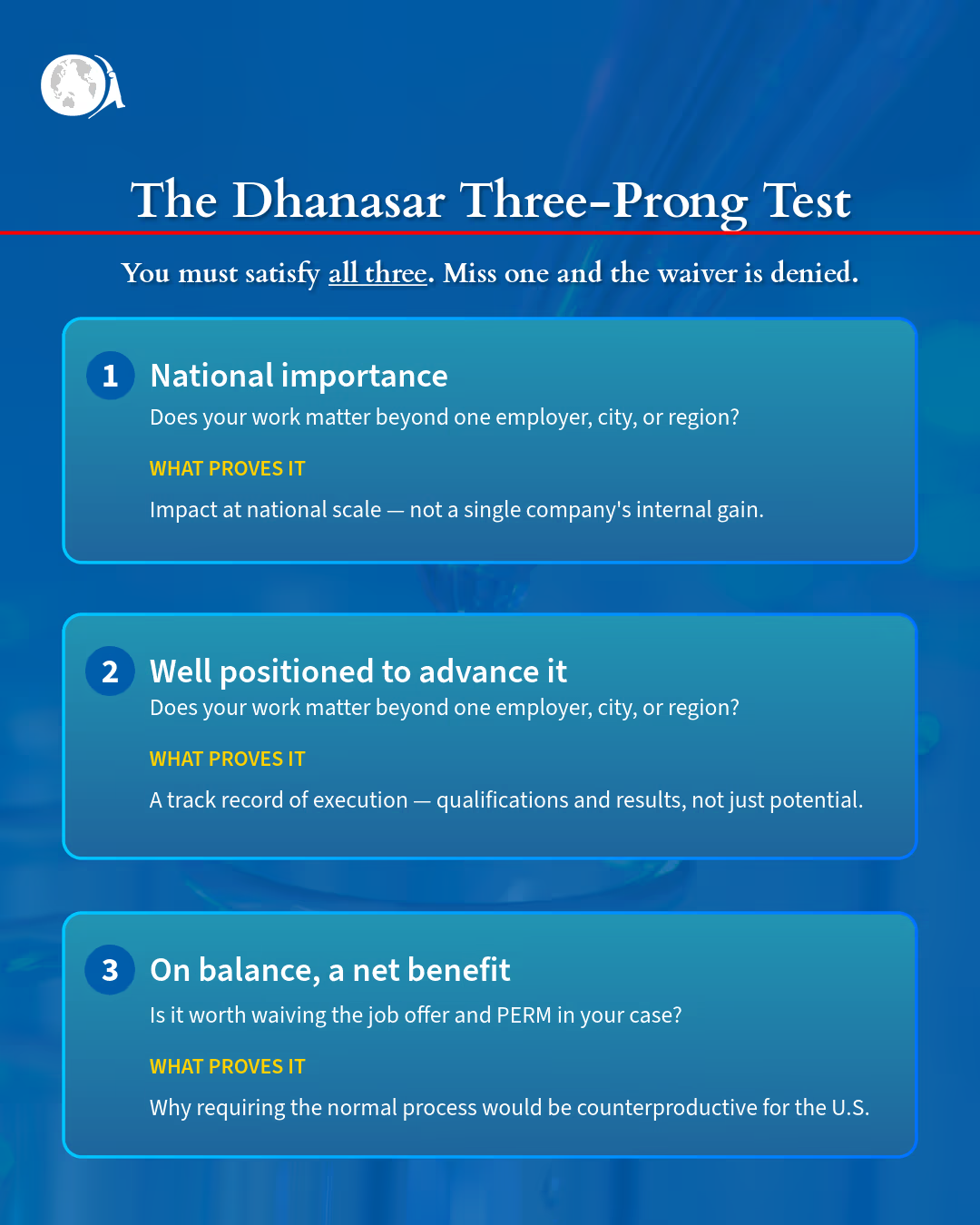
Prong 1 requires you to show that your proposed endeavor has substantial merit and national importance. The benefit must extend beyond purely local effects. It’s not enough for a region, single company, or municipality to benefit from your work.
Prong 2 asks whether you are well-positioned to advance the proposed endeavor. USCIS looks at your track record, qualifications, and resources.
Prong 3 evaluates whether, on balance, waiving the job offer and labor certification requirements benefits the United States.
In January 2025, USCIS published updated guidance clarifying how these prongs apply. For exceptional ability applicants, your exceptional ability must relate directly to the endeavor you’re proposing. USCIS evaluates this relationship case-by-case, considering shared skillsets, knowledge, or expertise.
In our work with NIW applicants, the strongest petitions demonstrate clear continuity between proven expertise and proposed endeavor. Identical credentials can produce different outcomes depending on how well you connect past achievements to future plans.
What “National Importance” Means in Your Field
USCIS recognizes certain fields as aligned with U.S. priorities: AI, renewable energy, biotechnology, public health, cybersecurity, and critical infrastructure. These areas receive favorable consideration.
Working in an advantageous field alone does not guarantee approval. You must show your specific work addresses a problem with national-scale impact, beyond a regional or institutional benefit.
For researchers: Peer-reviewed publications and citations demonstrate impact beyond your institution. If other scientists cite your work to advance their own, you’re contributing to national progress.
For entrepreneurs: Job creation alone is typically insufficient. You must show innovation in critical sectors or solutions to public problems at scale.
For healthcare professionals: Addressing underserved populations or advancing treatment methodologies demonstrates national-scale benefit. USCIS looks for systemic impact, reducing health disparities or developing protocols others can adopt.
For tech professionals: Contributions to open-source projects, industry-standard tools, or widely adopted code demonstrate broad impact beyond a single employer.
A common mistake is confusing “important work” with “nationally important work.” A breakthrough discovery in a university lab has national importance. The same quality of work applied to a single company’s internal processes typically doesn’t.
Key Insight: Before drafting your petition, map your work to a recognized priority area. If it does not clearly connect, identify the national-scale problem it solves and gather evidence of impact beyond your immediate employer or region.
Evidence Requirements: Building Your Case
Strong evidence separates approved NIW petitions from denials. You need documentation proving you meet EB-2 base requirements and satisfy all three Dhanasar prongs.
For academics and researchers, USCIS expects peer-reviewed publications with citation counts, patents, research grants, and awards. Citation count matters more than publication volume. 10 highly cited papers carry more weight than 50 rarely cited ones.
All applicants need recommendation letters from independent experts in your field. These cannot come solely from colleagues or supervisors at your current institution. USCIS looks for letters from recognized authorities who can objectively assess your contributions.
Expert letters should address all three Dhanasar prongs, not just praise your qualifications. A strong letter explains why your proposed endeavor has national importance, how your background positions you to advance it, and why waiving the job offer requirement benefits the United States.
If you are an entrepreneur, your business plan must demonstrate feasibility through market analysis and national-scale impact projections. You need financial projections, competitive analysis, and evidence of early traction.
Non-traditional evidence increasingly carries weight: GitHub contributions, open-source project leadership, industry conference presentations, and media coverage. USCIS recognizes that impact takes many forms beyond traditional academic metrics.
Common Mistakes That Trigger RFEs
The January 2025 USCIS guidance update clarified a pattern: many RFEs stem from petitioners proving credentials without connecting them to their proposed endeavor. The stakes have risen. NIW approval rates ran near 71% in fiscal year 2024, fell to roughly 55% in fiscal year 2025, and stood at approximately 43% in the first quarter of fiscal year 2026.
USCIS is applying the Dhanasar prongs more strictly and increasingly expects measurable, quantifiable evidence of national-scale impact rather than general statements about the importance of a field. Petitions that would have cleared the bar two years ago are now drawing RFEs.
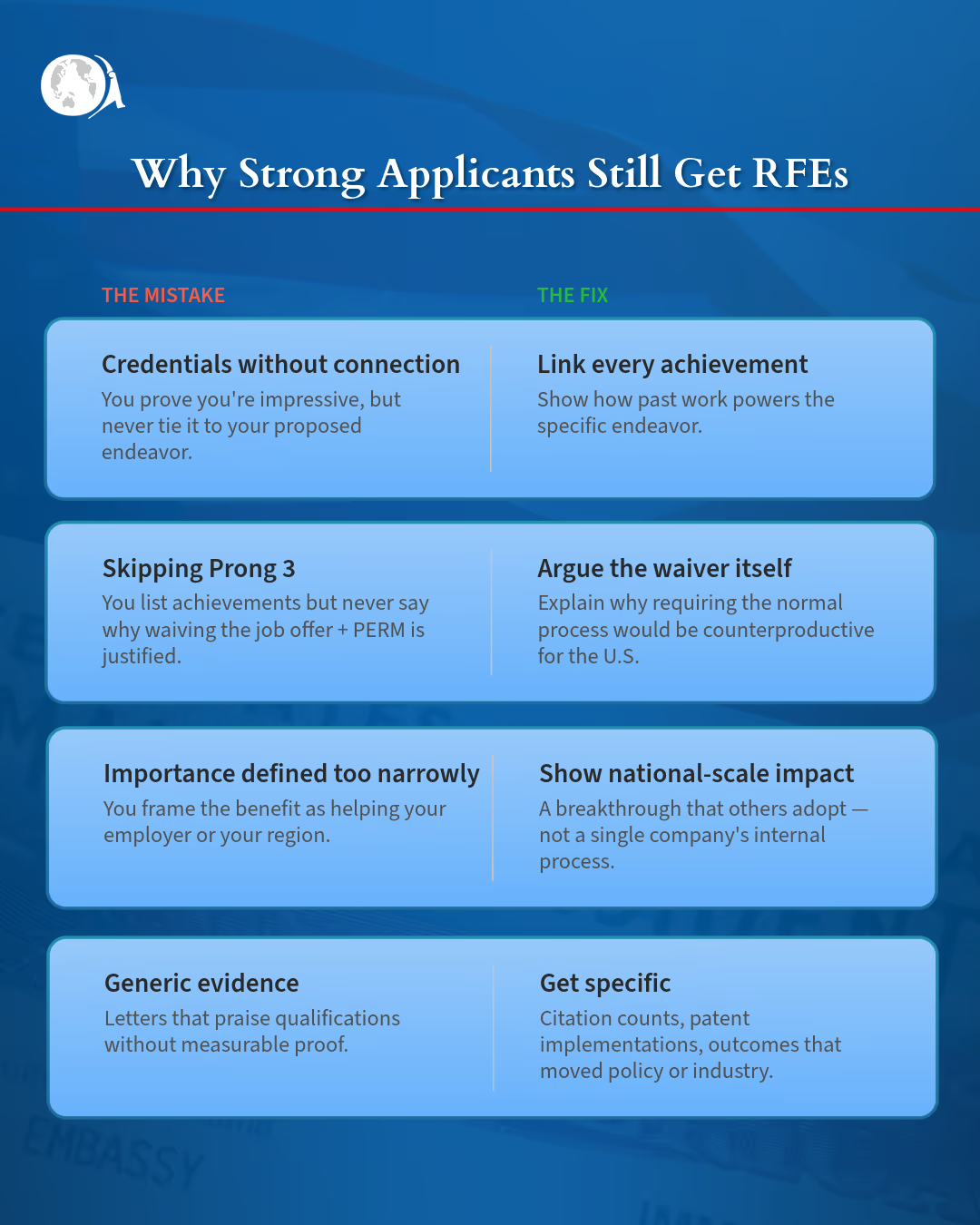
Prong 3 must be addressed. You are able to demonstrate impressive achievements, but fail to show how waiving the job offer and labor certification specifically benefits the United States. USCIS wants to understand why enforcing normal EB-2 procedures would be counterproductive to the national interest.
Many petitioners define national importance too narrowly. Focusing on how your employer benefits or how your region gains economic advantage does not satisfy the Dhanasar framework.
“Positioned to advance” requires more than credentials. USCIS examines your track record of execution, not just potential. Letters stating “Dr. Smith has exceptional qualifications” without addressing the three-prong test fail to address the required criteria.
In our work with NIW clients, we see entrepreneurs overemphasize job creation while underemphasizing innovation. Creating jobs is not viewed as strongly as solving a documented national problem through technology that others have not addressed.
Generic evidence weakens your case. USCIS wants specificity: citation counts, patent implementations, research outcomes that influenced policy or industry practice.
The I-140 Petition Process
Form I-140 (Immigrant Petition for Alien Workers) is the required petition form that must be submitted directly to USCIS with all supporting evidence.
Include a completed but uncertified Appendix A Form ETA-9089. For labor certification applications filed on or after June 1, 2023, use the Foreign Labor Application Gateway (FLAG) system.
As a self-petitioner, you may file on your own behalf with no employer signature required.
Premium Processing for NIW Petitions
Premium processing is available for EB-2 NIW petitions through Form I-907, at a filing fee of $2,965 as of March 1, 2026. NIW petitions carry a 45-business-day adjudication window rather than the 15 business days that apply to some other categories. Within that window, USCIS must approve the petition, deny it, issue a Request for Evidence, or issue a Notice of Intent to Deny. If USCIS issues an RFE, the clock restarts when you submit your response.
Because NIW petitioners self-sponsor, premium processing is one of the few points in the process you directly control. It is worth understanding what it does and does not buy: it accelerates the I-140 decision only. It has no effect on your priority date or your place in the visa queue, so for applicants facing a multi-year backlog, the practical benefit is earlier certainty, not an earlier green card.
Processing Times and Priority Date Backlogs
I-140 approval does not, on its own, afford you a green card. You must wait until your priority date becomes current under the monthly Visa Bulletin. Your priority date is the date USCIS receives your I-140 petition. This date determines your place in line for a green card, not the approval date.
The State Department publishes the Visa Bulletin monthly. During the wait, you can maintain status with work authorization if you have a valid non-immigrant visa (H-1B, L-1, O-1, or similar). Your approved I-140 preserves your priority date even if you change employers.
Backlogs vary sharply by country of birth, and the picture has worsened in 2026. As of the August 2026 Visa Bulletin, EB-2 India is unavailable for the remainder of fiscal year 2026 — the prorated annual limit for that category has been reached, so no visa numbers are being issued. The State Department has indicated that India EB-2 should become available again at a cutoff around July 15, 2014 or earlier when the new fiscal year opens on October 1, 2026. EB-2 China remains at a September 1, 2021 cutoff, and the State Department has warned that continued demand may require further retrogression or unavailability later in the fiscal year. Rest-of-World applicants face a shorter wait, but these dates move every month and can move backwards as well as forwards.
Key Insight: Check the current Visa Bulletin to understand priority date wait times for your country of birth before planning your timeline.
After I-140 Approval: Adjustment of Status vs Consular Processing
Once your I-140 is approved and your priority date is current, there are two ways to obtain permanent residence:
- Adjustment of status (Form I-485) if you’re in the United States; or
- Consular processing if you’re abroad.
Adjustment of status must consider the new memorandum issued by the administration relating to discretion in granting adjustment. We recommend that you speak to competent counsel about this new consideration.
Consular processing, when you receive your immigrant visa outside the United States, requires an interview at a U.S. embassy or consulate.
If you’ve overstayed a visa or worked without authorization, departure from the United States for consular processing might trigger inadmissibility bars. It is therefore imperative to speak with competent counsel to determine eligibility.
Your spouse and unmarried children under 21 can be included as derivative beneficiaries, receiving green cards through your approved I-140.
If you’re subject to the J-1 two-year home residency requirement under INA §212(e), you must obtain a J-1 waiver before completing your green card process.
Adjustment of status lets you remain in the U.S. during processing. You can apply for work authorization (EAD) and a travel document (advance parole) while your I-485 is pending.
The Bottom Line: Review your complete immigration history before choosing between adjustment of status and consular processing. Any gaps in status or prior violations change the calculus significantly.
EB-2 NIW vs Other Self-Petition Options
Each self-petition pathway has different evidentiary standards, processing times, and strategic advantages.
If you qualify for EB-1A, it’s almost always the better choice. No priority date backlog for most countries means faster permanent residence.
The EB-1A Alternative
EB-1A requires sustained national or international acclaim. USCIS expects major awards, extensive media coverage, or top-tier recognition. EB-2 NIW has a lower bar but longer processing due to priority date backlogs.
Filing Both Simultaneously
The legal standards differ, resulting in USCIS approving one and not the other. For example, in our work with clients in AI and biotechnology, we have seen the same evidence portfolio yield different results under each standard. There is no limitation on what applications may be filed as long as they are legitimate. The additional filing fee may be worth the strategic hedge.
O-1 Visa and Schedule A
An O-1 visa grants temporary status for extraordinary ability. It requires employer sponsorship and doesn’t directly lead to permanent residence.
Schedule A streamlines EB-2 and EB-3 for nurses, physical therapists, and certain scientists or performing artists. It skips labor certification but still requires employer sponsorship.
| Pathway | Self-Petition | Standard | Processing | Permanence |
|---|---|---|---|---|
| EB-1A | Yes | Extraordinary ability (sustained acclaim) | No backlog (most countries) | Permanent |
| EB-2 NIW | Yes | Professional or exceptional + national interest | 1-2 year backlog (Rest of World); India unavailable through FY2026; China backlogged to Sept 2021 | Permanent |
| O-1 | No (employer required) | Extraordinary ability | Temporary | Temporary |
| EB-2 EB-3 Schedule A | No (employer required) | EB-2 EB-3 base requirements | Skips PERM | Permanent |
Frequently Asked Questions
Can I apply for EB-2 NIW without a job offer?
Yes. The NIW waives both the job offer and labor certification requirements. You file Form I-140 on your own behalf without employer sponsorship. You can change employers or work independently while your petition is pending. However, you must demonstrate that your proposed work serves the national interest under the Matter of Dhanasar three-prong test.
How long does the EB-2 NIW process take from start to green card?
The process has two stages: I-140 petition approval, then waiting for your priority date to become current before filing I-485. After I-140 approval, Rest of World applicants typically wait 1-2 years. Applicants born in India or China face longer backlogs. NIW saves considerable time by waiving PERM compared to a regular EB-2. If you’re subject to J-1 two-year home residency requirements under INA §212(e), you must obtain a J-1 waiver before completing the process.
What’s the difference between “exceptional ability” and “extraordinary ability”?
Exceptional ability (EB-2) means expertise significantly above that ordinarily encountered in the sciences, arts, or business. You must meet at least three specific criteria. Extraordinary ability (EB-1A) requires sustained national or international acclaim at the very top of your field. EB-2 is a lower threshold. For NIW, your exceptional ability must relate to the endeavor you’re proposing—USCIS evaluates this on a case-by-case basis.
Can I change jobs or employers after filing EB-2 NIW?
Yes. Because NIW doesn’t require employer sponsorship, you’re not tied to a specific company. You can move freely within the U.S. labor market after filing your I-140. However, your actual work should remain aligned with the proposed endeavor described in your petition.
What happens if I receive an RFE (Request for Evidence)?
An RFE means USCIS needs additional documentation to evaluate your petition. You’ll receive a notice specifying what evidence is missing or insufficient. USCIS sets the deadline in the notice itself, and it is typically up to 87 days. Common RFE topics include demonstrating national importance, proving you’re well-positioned to advance your endeavor, or clarifying how waiving normal EB-2 requirements benefits the U.S.
Do I need a lawyer to file an EB-2 NIW?
USCIS does not require legal representation. However, NIW cases are legally complex and evidence-driven. You must build a persuasive argument under all three Dhanasar prongs. Most successful petitioners work with immigration attorneys experienced in NIW cases who help structure evidence, draft legal arguments, and respond to RFEs.
Can my spouse and children get green cards through my EB-2 NIW petition?
Yes. Your spouse and unmarried children under 21 can apply as derivative beneficiaries. After your I-140 is approved and your priority date becomes current, you file Form I-485 alongside yours or complete consular processing abroad. Your spouse can also apply for work authorization (EAD) while the I-485 is pending.
What to Do Next
This week:
- Review your credentials against both EB-2 qualification paths (advanced degree or exceptional ability) to confirm you meet the baseline.
- Map your work to recognized national priority areas like AI, clean energy, biotech, public health, cybersecurity, or critical infrastructure. Or identify the specific national-scale problem your work solves.
Check the current Visa Bulletin for priority date wait times based on your country of birth.
This month:
- Gather evidence of past achievements: peer-reviewed publications, patents, awards, research grants, and projects with demonstrable impact beyond your immediate employer.
- Identify 3-5 independent experts who can write recommendation letters addressing the Matter of Dhanasar framework—not just praising qualifications but explaining why waiving normal EB-2 procedures serves U.S. national interests.
Ongoing:
- Monitor USCIS policy updates and the Visa Bulletin monthly. Processing times and priority dates change regularly.
Document your ongoing work and impact in the field described in your petition, even after filing. USCIS may request updated information, and continued achievement strengthens your case.
This article is provided for informational purposes only, and does not constitute legal advice nor does it create an attorney–client relationship with Oltarsh & Associates, P.C. or any of its lawyers, employees and/or agents. Laws and policies change, and information here may not reflect the most current legal developments. You can contact us about your specific situation.



 English
  Español