


The EB-1A visa, the Employment-Based First Preference for Individuals of Extraordinary Ability, is a more expedited path to U.S. permanent residency for foreign nationals at the very top of their field. Unlike other employment-based green cards, it requires no U.S. employer sponsor and no labor certification.
The approval standard, however, is deliberately high. USCIS uses a two-part evaluation that first checks minimum threshold criteria and thereafter assesses whether the total body of work demonstrates sustained national or international acclaim.
EB-1 visa issuance grew from 1,680 in 2014 to 3,854 in 2018, according to U.S. State Department data. Yet most applicants still misunderstand what “extraordinary ability” requires. Meeting three of the ten criteria gets you past the threshold, but under the current interpretation, that alone will not guarantee approval.
What You’ll Learn
- How USCIS’s two-part evaluation process works — and why meeting 3 criteria isn’t enough
- What each of the 10 EB-1A criteria actually means, with field-specific examples
- How to self-assess your readiness using diagnostic questions that reveal weak spots before you invest in legal fees
- The strategic differences between EB-1A, EB-2 NIW, and EB-1B
- Common rejection reasons and how to build evidence that passes the final merits determination
What Is the EB-1A Extraordinary Ability Visa?
The EB-1A (extraordinary ability) is an employment-based first preference immigrant visa for individuals at the very top of their field. It affords a Green Card to qualified applicants without requiring a U.S. employer sponsor or PERM labor certification.
You can qualify in five fields: sciences, arts, education, business, or athletics. The EB-1A allows you to self-petition, meaning you act as your own sponsor on Form I-140. Having a sponsor, however, can add to the viability of the petition.
The other EB-1 subcategories, EB-1B (outstanding professors and researchers) and EB-1C (multinational managers and executives), both require employer sponsorship.
| Visa Type | Requires Employer? | Status | Key Requirement |
|---|---|---|---|
| EB-1A | No (self-petition) | Immigrant (permanent) | Extraordinary ability with sustained national or international acclaim |
| EB-1C | Yes | Irant (permanent) | Multinational transfer of Executive or Manager with 1 year of work for company overseas |
| EB-2 | Yes with exceptions | Immigrant (permanent) | Advanced degree or exceptional ability |
COMPARE – O-1 visa also requires extraordinary ability in the field of expertise, but it is a non-immigrant visa with no immigrant intent.
The EB-1 categories, conversely, are for permanent residency, unlike the O-1, which is an application for a non-immigrant temporary visa. The EB-1A also applies higher scrutiny through its “final merits” standard than the O visa, requiring applicants to demonstrate sustained acclaim, not just meet a threshold.
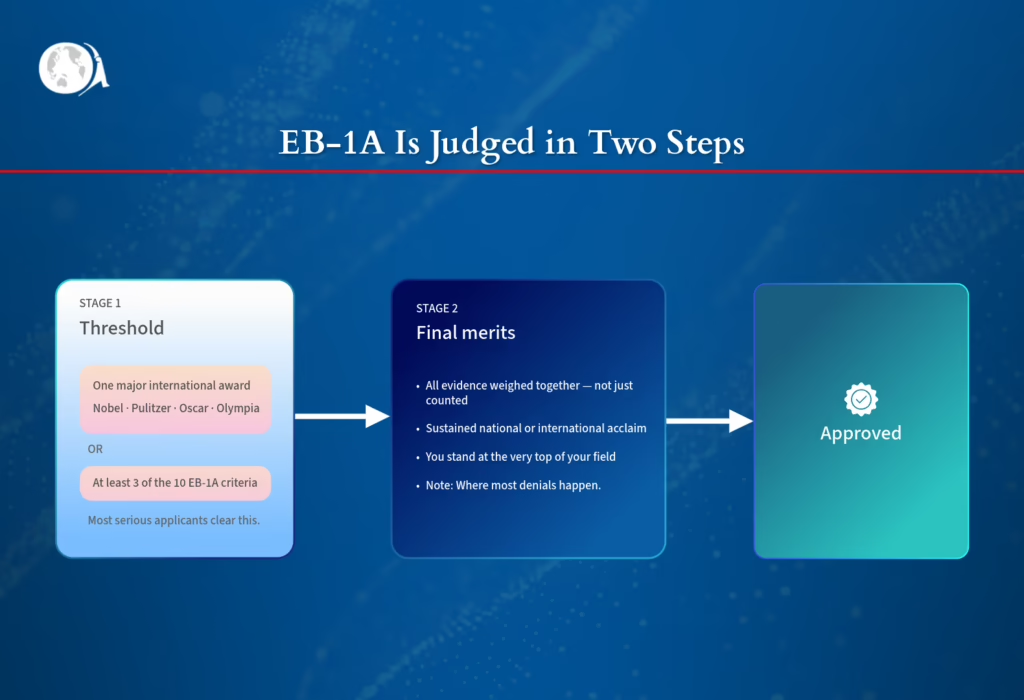
USCIS evaluates every EB-1A petition using a two-step framework established by the Kazarian v. USCIS (https://www.uscis.gov/laws-and-policy/other-resources/policy-manual-afm-archive/chapter-22-employment-based-petition).
Step 1: Threshold Analysis. You must show either one major internationally recognized award (Nobel Prize, Pulitzer Prize, Academy Award, Olympic Medal) OR meet at least 3 of the 10 prescribed USCIS criteria. Most applicants use the three-criterion path.
Step 2: Final Merits Determination. USCIS reviews all evidence collectively to determine whether you’ve risen to the very top of your field with sustained national or international acclaim.
In our work with EB-1A clients, we see the same pattern repeatedly: applicants who may meet the criteria for step one but fail to address step two. Clearing the threshold is necessary but not sufficient. The final merits review determines whether your achievements truly place you at the pinnacle of your profession.
The 10 EB-1A Criteria: What Each One Actually Means
USCIS requires that the applicant qualify for at least three of the 10 criteria, absent a one-time major internationally recognized award.
The criteria aren’t weighted equally in practice. Original contributions (Criterion 5) and media coverage (Criterion 3) tend to carry more weight during final merit determination.
| Criterion | What It Measures | Example Evidence |
|---|---|---|
| 1. Awards | Lesser nationally/internationally recognized prizes | Industry awards, grants, fellowships |
| 2. Memberships | Associations demanding outstanding achievement | Selective professional societies |
| 3. Media Coverage | Published material about you in major media | News articles, profiles, interviews |
| 4. Judging | Judging others’ work individually or on a panel | Peer review, editorial boards |
| 5. Original Contributions | Contributions of major significance | Patents, methodologies, breakthroughs |
| 6. Authorship | Scholarly articles in professional publications | Journal publications, book chapters |
| 7. Exhibitions | Work displayed at artistic showcases | Gallery shows, museum exhibitions |
| 8. Leadership | Leading/critical role in distinguished organizations | Executive or key technical roles |
| 9. High Salary | Significantly high remuneration vs. field peers | Compensation data, contracts |
| 10. Commercial Success | Box office receipts, record sales (performing arts) | Sales figures, streaming data |
Field-Specific Qualification Standards
The same criteria apply differently depending on your field.
Sciences and research: USCIS looks for high citation counts, publications in high-impact journals, and peer review invitations. Your h-index matters more than raw paper count.
Technology: Focus on patents, critical roles at companies with significant market impact, and top-percentile compensation.
Business: Document revenue growth, company valuations, and media coverage in major publications.
Arts: Exhibition records at notable galleries, critical reviews, awards from juried competitions, and commercial success measured by sales figures.
Athletics: Competition results at national or international levels. College-level achievement rarely qualifies.
The most common mistake is forcing achievements into criteria designed for different fields rather than selecting the three criteria that naturally showcase your accomplishments.
EB-1A vs. EB-2 NIW vs. EB-1B: Choosing the Right Category
| Category | Standard | Sponsor Required | Experience Required |
|---|---|---|---|
| EB-1A | Very top of field | No (self-petition) | None specified |
| EB-2 – NIW | Work in the national interest | Not required, but can assist to have a sponsor | Advanced degree |
| EB-1B | Outstanding in academia | Yes (employer) | 3+ years teaching/research |
The EB-1A visa rarely faces visa backlogs. EB-2 has seen enormous retrogression for Indian and Chinese nationals,, creating multi-year waits.
If you have previously filed an employment-based petition, you may maintain the earlier priority date when you file a new petition. As a consequence, if you are in EB-3 or EB-2, filing an EB-1, for example, may result in the applicant becoming current or reaching that point much earlier.
Self-Assessment: Are You Ready to File?
Before filing an I-140 petition, run through these diagnostic questions.
Can you identify at least three criteria with strong, documented evidence right now? Not prospective evidence, but evidence that you currently possess.
Does your evidence span multiple years? USCIS looks for sustained acclaim. A recent spike won’t demonstrate consistency, although each type of evidence can cumulatively demonstrate eligibility..
Has your work had major significance beyond your immediate organization? Contributions that only benefited your employer likely will not meet the threshold.
Do you have independent validation — awards, media coverage, peer recognition? Being promoted to VP doesn’t prove you’ve risen to the very top of your field; the evidence must demonstrate a sustained acclaim outside your employer.
Red flags: Only meeting two criteria. All evidence from one employer. No external recognition.
Green flags: 3+ criteria met with documentation. Multi-year track record. National or international recognition from independent and valuable sources.
If your case is borderline, waiting to strengthen and build your case may be smarter than filing right away and facing a denial.
Building a Strong EB-1A Visa Case: Evidence Strategy
Evidence quality beats volume, although both are important. In practice, a focused petition with 100 compelling pages outperforms 500 pages of marginally relevant documents.
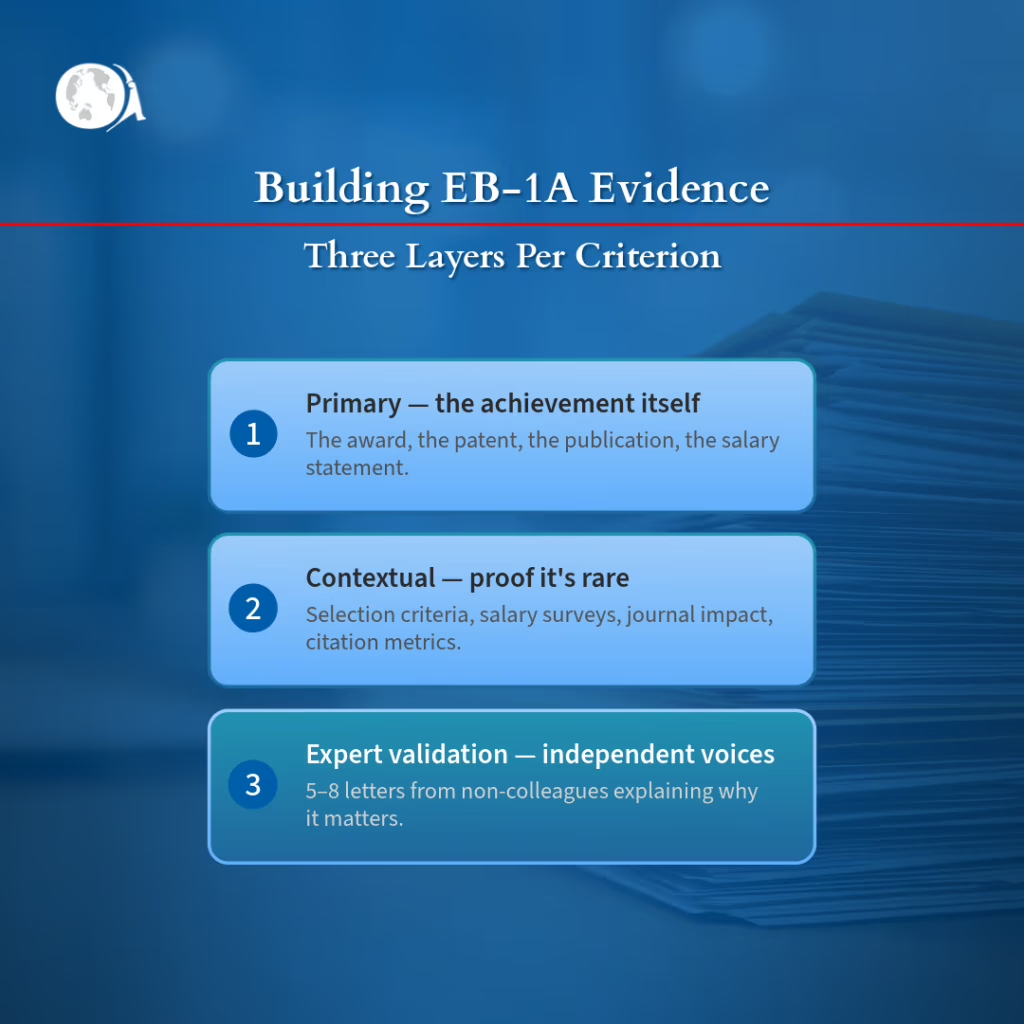
Letters of recommendation: Get 5-8 letters from experts, including independent sources and not merely colleagues. Each must explain specific contributions and their significance, as well as how the writer has the knowledge to render an opinion about you and your work.
Citation analysis: Provide Google Scholar or Web of Science metrics showing other researchers rely on your work.
Media coverage: National or international press in major outlets carries weight. Industry blogs don’t meet the threshold.
Salary evidence: Include salary surveys or H-1B LCA data showing top-percentile compensation. USCIS wants proof that you command compensation significantly above others in your field.
Original contributions: Demonstrate that your work has been cited, adopted, or used by others. USCIS wants proof of how and why your work influenced the field.
For each criterion, gather three tiers of evidence: primary (the award, publication, salary statement), contextual (selection criteria, salary surveys), and expert validation (letters explaining significance).
The EB-1A Visa Application Process: Form I-140 and Beyond
The EB-1A application and obtaining permanent residence have two steps: the preference petition (Form I-140 and the Green Card. These can be applied for simultaneously if the priority date is current. However, at this time, it might be advisable to file the EB-1 petition on its own. Under either scenario, it is important that you remain in status outside of a pending permanent residence application. To protect the right to remain in the United States, we are promoting that the I-140, in general, be applied for initially and, upon approval, thereafter file for permanent residence.
Step 1: File Your I-140 Petition
Submit Form I-140 with evidence demonstrating you meet at least three of the 10 criteria. Gather and present your evidence in an understandable manner. Verify current filing fees on the USCIS fee schedule. Premium processing offers 15-day adjudication for an additional fee.
You must prove your intent to continue working in your field of expertise in the United States. Acceptable proof includes a letter from a potential employer, non-binding letters from potential clients, or your own letter explaining how you’ll continue your professional work.
Step 2: Apply for Your Green Card
| Path | Who It’s For | Form |
|---|---|---|
| Adjustment of Status | Already in U.S. with valid status | Form I-485 |
| Consular Processing | Outside U.S. | DS-260 |
Although many individuals who file for EB-1 are in a legal work-authorized status, such as an H-1B, which has dual intent, there is, at the time of this writing, a memorandum from the administration about adjustment of status that may impact the case, although there was a recent walk-back regarding adjustment of status and the memorandum’s intent. It is best to speak to a competent attorney before deciding which path to choose.
For individuals outside the United States, following the approval of the I-140, the case is transferred to the National Visa Center to begin consular processing. An interview will then occur at a U.S. consulate overseas. Processing time depends on which US Consulate is making the determination, and times vary considerably.
The Bottom Line: The EB-1A visa rarely has waiting periods because the annual quota is seldom exceeded. When backlogs occur, wait times are typically short and thus may provide a more expedited manner to obtain permanent residence.
Common EB-1A Rejection Reasons and How to Avoid Them
The USCIS must be satisfied that the applicant meets three of the ten criteria. In addition to meeting the criteria, USCIS also evaluates the evidence collectively to determine merit.
Issues to consider for the application:
Regional vs. National Scope: Local recognition — a university teaching award, city newspaper coverage — may fail the national or international acclaim standard. The more prestigious the award and the greater the breadth of recognition, the better the evidence.
Timeframe Issues: Achievements concentrated in one to two years may give rise to questions about sustained acclaim.
Weak Letters: Letters from individuals who are themselves not highly prestigious carry less weight than independent expert testimonials. Furthermore, letters only from colleagues will likely not satisfy the criteria for national or international acclaim if those are the only individuals who know and recognize your work.
Low-Impact Publications: Articles with minimal citations will fail to demonstrate major significance. In addition, the more prestigious the publishing journal, the more valuable the publication.
Salary Without Context: A high salary alone fails to prove that remuneration is above the norm without comparative data showing greater compensation relative to field peers nationally.
Responding to an RFE: Many cases, even if presented well initially, now face requests for evidence (RFE). Carefully respond to the USCIS concerns and address each specific issue USCIS raised. New evidence may be submitted to support your arguments and directly counter USCIS concerns.
Frequently Asked Questions
How do I know if I qualify for an EB-1A visa?
You qualify if you have received a major internationally recognized award (Nobel Prize, Olympic Medal, etc.) or meet at least 3 of 10 USCIS-prescribed criteria. Meeting the threshold is just step one — USCIS then evaluates whether you have risen to the very top of your field with sustained national or international acclaim.
What’s the difference between an EB-1A and an O-1 visa?
The EB-1A is an immigrant visa leading directly to a Green Card and allows self-petition. The O-1 is a temporary work visa requiring employer sponsorship. The EB-1A visa applies a “final merits” standard with generally higher scrutiny than the O-1’s threshold.
Can I apply for EB-1A without a job offer?
Yes. You must prove your intent to continue working in your field in the United States. Acceptable proof includes a letter from a potential employer, non-binding letters from potential clients, or your own letter explaining how you’ll continue your work.
How long does the EB-1A process take?
The EB-1A visa rarely has waiting periods because the annual quota is seldom exceeded. EB-1A’s priority worker status means faster movement than EB-2 or EB-3 categories. Premium processing provides 15 business-day adjudication of the I-140, but it cannot speed up the visa priority wait-time.
What happens if my EB-1A petition is denied?
You can file a motion to reopen or reconsider, or submit a new petition with stronger evidence. Denial doesn’t prevent future applications. You might also consider EB-2 NIW as an alternative path with a lower “exceptional ability” standard.
Do I need to meet all 10 EB-1A criteria?
No. You need at least 3 of the 10 criteria, unless you’ve won a major internationally recognized award. Meeting more than 3 strengthens your case during the final merits determination, but it isn’t required.
Can software engineers qualify for EB-1A?
Yes. Technology professionals often qualify through high salary relative to the field, original contributions of major significance (patents, widely adopted technologies), published articles, and judging others’ work (peer review, conference committees).
What to Do Next
This week:
- Create a spreadsheet listing the 10 EB-1A criteria and document what evidence you have today for each one. You need to see your gaps before you can fill them.
- Identify 5-8 independent experts who could write letters about your work’s impact. These letters carry more weight than anything your employer writes.
This month:
- If you have strong evidence for 3+ criteria, schedule consultations with immigration attorneys experienced in EB-1A petitions. These are complicated cases, and for such an important application, it is best to have someone who can present the evidence in the best light to gain approval and who, through experience, understands the process as well as the final merits evaluation.
- If you are borderline, identify which criteria you are closest to meeting and create a 6-month plan. It is best not to file until you are confident that you meet at least three criteria and have evidence to convincingly demonstrate eligibility — a denial makes future applications harder.
Ongoing:
- Document achievements as they happen — awards, media coverage, peer review invitations, salary increases. Evidence is easier to gather in real-time than months later when you’re scrambling to file.
This article is provided for informational purposes only, and does not constitute legal advice nor does it create an attorney–client relationship with Oltarsh & Associates, P.C. or any of its lawyers, employees and/or agents. Laws and policies change, and information here may not reflect the most current legal developments. You can contact us about your specific situation.



 English
  Español