


The E-2 visa lets treaty country nationals live and work in the U.S. by investing in and actively managing a U.S. business. Unlike other employment-based visas that tie you to a specific employer, an E-2 ties you to your own investment, or the investment made by a fellow national of the same country.
But the approval process is less straightforward than the concept. Consular officers and USCIS adjudicators apply a layered legal standard — one that trips up applications at the investment threshold, the marginality test, and the source-of-funds stage.
The stakes are real. You’re committing capital before you know the visa outcome. Depending on the business, that could mean $100,000 or more already put into the stream of commerce before a consular officer opens your file.
Denial rates vary by consulate and nationality, and the U.S. Department of State does not publish a single aggregate approval rate for E-2 petitions. What’s consistent: incomplete business plans and underdeveloped financial projections are common reasons for denial.
This guide covers what the legal standard actually requires and where most applications fall short before they’re ever submitted.
What You’ll Learn
- Understand the exact legal standards USCIS and consular officers use to evaluate E-2 applications
- Determine whether your investment funds qualify as ‘at risk’ under 8 CFR 214.2(e)(12)
- Why the E-2 isn’t a green card path, and which categories are
- Understand what a business plan must demonstrate to pass the marginality test
- Map out realistic long-term pathways from E-2 status toward permanent residency
Who Qualifies for an E-2 Visa: Nationality and Treaty Country Eligibility
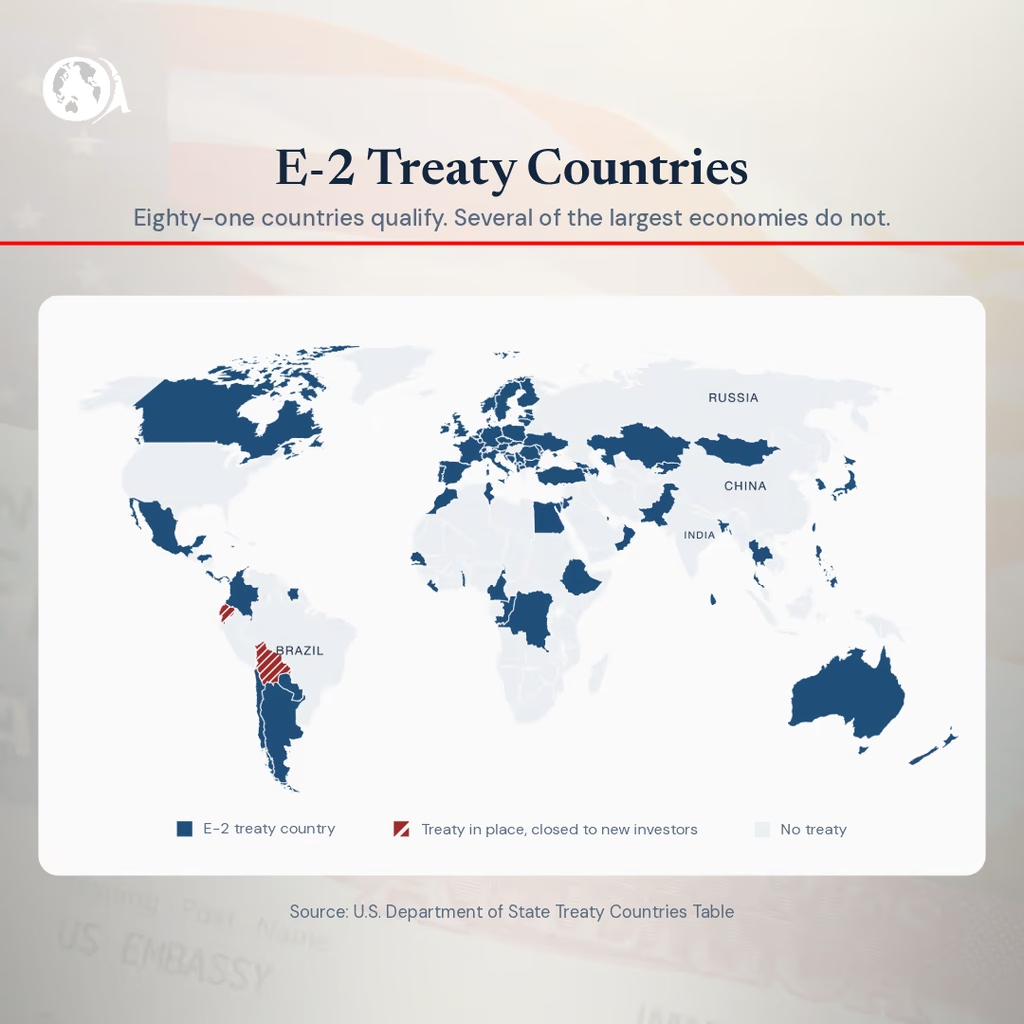
The E-2 visa is only available to nationals of countries with a qualifying treaty of commerce and navigation with the United States. If your country isn’t on that list, you cannot apply, no matter how much you plan to invest.
Qualifying requires meeting five requirements simultaneously.
Nationality is the first criterion. You must be a citizen of a treaty country. U.S. permanent residents (green card holders) are excluded in the review of who owns the company for foreign nationality.
Ownership is the second consideration. Generally, for closely held companies, at least 50% of the U.S. enterprise must be owned by treaty nationals. USCIS is looking for a controlling interest. Voting rights should align with ownership.
Role is the third. The principal obtaining the visa must develop and direct the business, hold at least 50% ownership or a controlling managerial position (not a passive stake), or be an essential employee.
Investment is the fourth. Funds must be substantial, at risk, and legally sourced. No statutory minimum exists, but “substantial” is measured relative to the total cost of the enterprise.
Enterprise is the fifth. The business must be real and actively operating — not a speculative or idle investment.
Germany’s treaty, for example, was signed October 29, 1954, and has been in force since July 14, 1956, showing how long-standing these agreements are. But notable countries are absent: China, India, Brazil, Russia, and Canada are all excluded. Other unusual countries remain included, including Iran. Foreign nationals from excluded countries may not file these visas and must pursue alternative pathways.
Dual nationals may qualify through either nationality, but the nationality used must match the ownership structure of the U.S. enterprise.
The full treaty country list is maintained by the U.S. Department of State. Verify your country’s status there before making any investment decision.
E-2 Investment Requirements: At-Risk Capital, Marginality, and Business Structure
The E-2 visa requires more than moving money into a U.S. bank account. USCIS requires some capital to be already in the “stream of commerce,” in other words, irrevocably committed to the enterprise, actively deployed, or contractually obligated before you file.
Funds sitting in a reserve account don’t qualify. Under 8 CFR 214.2(e)(12), uncommitted or revocable funds are not considered an investment.
The money must be subject to risk of loss. Funds tied to criminal activity automatically disqualify an investment, regardless of amount.
Your investment must be non-de minimis and substantial relative to the total cost of the enterprise. A $100,000 investment might be appropriate for a dry cleaner but not for a hotel. In other words, a $100,000 investment in a business valued at $150,000 is very different than the same investment in a $2,000,000 operation.
Marginality is also a criterion. The investment must be substantial, which is not defined. If, however, the investment is too small, USCIS may deny the petition based on marginality. In addition, if your business will generate only enough income to support you and your family, USCIS will deny the application.
The business must either produce income beyond a personal living wage or demonstrate meaningful economic impact through job creation, revenue growth, or contribution to the U.S. economy.
A credible five-year business plan is your primary tool for proving non-marginality. Illusory and vague projections or revenue projections that barely cover operating costs and your salary are red flags.
Your business structure and history also matter. Purchases of existing franchises and business acquisitions carry less scrutiny as they often have proven revenue history. New startups face a higher bar because officers evaluate projections with no historical performance to anchor them. These requests often result in a one-year visa to allow time to start-up operations. The renewal will receive heightened scrutiny.
Action Step: Before filing, document every transaction through which your investment funds passed — every account, every entity, every transfer. USCIS requires evidence that funds are legally sourced, that you know their origin, and that you have actively used some of them.
Applying for an E-2 Visa: Process, Costs, and Processing Times
Where you apply determines everything. Your location (inside or outside the U.S.) dictates which path you take, how long it takes, and what it costs.

If you’re inside the U.S., you file Form I-129 with USCIS to request a change of status to E-2 classification. This allows the bearer to remain and begin work in the United States. It does not allow for travel. If travel is necessary, you must repeat the entire process at the appropriate consulate, which will review the materials and make an independent adjudication without regard to USCIS’ review.
If you’re outside the U.S., you apply directly through a U.S. Embassy or Consulate.
The nonimmigrant base visa application fee is $1,015 for a company with 26 or more full-time employees; for smaller employers with 25 or fewer full-time employees, the fee is $510. There are now additional Asylum program fees required of all business-related visa applicants, which are $600 for large employers and $300 for small employers. Please check the filing fees, as work-related visa requirements have changed repeatedly over the past few years. The fees to the U.S. Consulate are much lower: $315, nonrefundable, per the U.S. Department of State, plus the normal visa processing fee. Depending on your nationality, a visa issuance reciprocity fee may also apply.
Processing times vary sharply by path and location.
| Factor | Consular Application | USCIS Change of Status (I-129) |
|---|---|---|
| Premium Processing | Not available | Available |
| Typical Wait | Weeks to several months | Varies by workload |
| Appointment Backlog | High at some posts | N/A |
| RFE Risk Factors | Business plan, ownership, at-risk capital | Same |
Premium processing is not available for consular E-2 applications — only for Form I-129 change of status filings with USCIS.
Requests for Evidence (RFEs), formal USCIS requests for more documentation, commonly trigger delays. Weak business plans and insufficient at-risk capital documentation each add months to your timeline. Unclear ownership structures do too.
In our work with E-2 applicants, consulate selection alone can mean the difference between a 3-week approval and a 6-month wait.
Action Step: Check current appointment wait times at your target consulate via the U.S. Department of State’s appointment scheduling system before deciding whether to apply abroad or pursue a change of status inside the U.S.
E-2 Validity, Extensions, Dependent Family, and Essential Employees
E-2 visa validity ranges from 3 months to 5 years. The exact duration depends on your country of origin and its reciprocal agreement with the U.S. But visa validity and authorized stay are two different things. Generally, for existing enterprises, the U.S. issues a visa valid for five years. Start-up companies often receive visas for one year.
An E-2 affords more time to oversee the investment. Each time you enter the United States, U.S. Customs and Border Protection (CBP) grants a maximum stay of 2 years documented on Form I-94. That 2-year clock applies regardless of how long your visa is valid. But if you enter close to the visa’s expiration, you still get a two-year period from your last entry, regardless of the visa’s expiration date.
The E-2 can be extended indefinitely. As long as you and your company continue to meet all requirements, there’s no hard time limit on renewals. This requires continued work for the qualifying company, and the company structure must remain predominantly owned by foreign nationals of the treaty country. Retirement is not a qualifying activity under an E-2 visa and requires active work.
Spouses and unmarried children under 21 may receive derivative E visas as dependents. Since November 2021, spouses can work in the U.S. without an Employment Authorization Document (EAD). However, children under 21 are not permitted to work.
Although family members usually receive visas for the same period as the principal, exceptions apply: family members with a different nationality than the principal investor have their visa duration set by their own country’s reciprocal agreement.
Essential employees: In addition to Executives or Managers, essential employees may also obtain E visas. The employee must share the treaty investor‘s nationality and show they are essential to the company. The first E-2 issued for a U.S. company must cover an owner, executive, manager, or essential worker.
Essential employees must fill an executive or supervisory role, or hold specialized skills unavailable in the U.S. labor market and not quickly trainable.
At the U.S. Consulate, the company must qualify for E status. Form DS-156E (Parts I, II, and III) is required. All applicants for an E visa must also file Form DS-160.
Does the E-2 Lead to a Green Card?
The E-2 visa is a nonimmigrant visa, and it carries nonimmigrant intent. E visa holders must have a permanent address overseas to which they plan to return. As a result, its criteria do not apply to the permanent residence category. If permanent residence is ultimately your goal, you need a separate immigration strategy.

There are several business-related paths to permanent residence, including EB-5, EB-1C (multinational manager or executive), labor certification through a different entity, or family-based immigration.
The Bottom Line: The E-2 is a business visa which affords long-term permission to remain in the United States and ensures that the business remains viable; it is not, however, a path to permanent residence.
Working With Oltarsh & Associates on Your E-2 Petition
E-2 applications are closely scrutinized, and approval is especially important because the investment must be made before the visa is approved. Proper structuring of the business, investment, and evidence is critical. Review the evidence before committing capital to ensure it supports both the enterprise and the visa.
At Oltarsh & Associates, we work with international investors in New York City to build the legal foundation before money moves. That means structuring the investment from the start to satisfy both the substantiality test and the at-risk requirement.
The business plan is where most petitions win or lose. We build financial projections that speak directly to the marginality requirement, showing USCIS the enterprise will generate income beyond supporting just the investor. Reviewers look for specifics. We provide them.
Documenting the lawful source of funds adds another layer of complexity, especially for investors moving capital across multiple jurisdictions. We coordinate that documentation whether funds originate from a business sale, real estate transaction, inheritance, or overseas savings.
E-2 status also requires ongoing attention. A significant change in your business, such as a new partner, a pivot in operations, or a revenue drop, can affect renewal eligibility. We track those circumstances and address them before they become problems at renewal.
Our practice is bilingual, serving New York’s international investor community in English and Spanish. Many clients navigate U.S. immigration law for the first time while building a business. We work in the language that’s clearest for them.
The decisions you make before filing determine what USCIS sees and how they decide.
Action Step: Schedule a consultation with Oltarsh & Associates before committing any investment capital. The structure you establish now shapes every step that follows.
Frequently Asked Questions
Who qualifies for an E-2 visa?
You must be a national of a country that holds a qualifying treaty with the United States; currently, over 80 countries participate. Your investment must be substantial, at-risk, and directed toward a real operating business, not a passive holding. For small closed corporations, the E-visa applicant’s nationality must own 50% of the enterprise. For larger enterprises, foreign nationals of the same country must hold a controlling interest. Check the U.S. Department of State’s treaty country list to confirm your nationality qualifies before building your application.
How much money do I need for an E-2 visa?
No fixed minimum exists, as the U.S. government uses a proportionality test instead of a set dollar threshold. For lower-cost businesses, consulates typically expect investments in the $100,000–$150,000 range to demonstrate seriousness, though some service-based businesses have been approved with less. Your investment must be proportional to the total cost of the enterprise and sufficient to make the business operational. A qualified immigration attorney can benchmark your specific investment against recent approvals in your industry.
Can an E-2 visa lead to a green card?
The E-2 visa does not provide a direct path to permanent residency. Unlike L visa holders or H-1B visa holders, which have dual nonimmigrant and immigrant intent, E-2 status has been deemed to require only nonimmigrant intent.
What are the disadvantages of an E-2 visa?
The E-2 visa’s biggest structural weakness is its nonimmigrant status, which offers no path to a green card. Your visa is also tied entirely to your business; if the enterprise closes or loses viability, your legal status is at risk. Renewals require you to demonstrate the business is still operational and generating more than marginal income. You must also remain committed to the enterprise full-time, which limits your ability to pivot or take outside employment in the U.S.
How long does E-2 visa processing take?
Processing timelines vary significantly depending on where you apply. Consular processing at a U.S. embassy abroad typically takes several months, and posts like London or Frankfurt can run longer. If you are already in the U.S. in a valid status and do not require overseas travel, you can file a change of status with USCIS, which currently takes months due to backlogs, but premium processing is available. Check the USCIS processing times tool for current estimates before committing to a launch timeline.
What happens if my E-2 business fails?
If your business fails, your E-2 status jeopardizes your legal basis to remain in the U.S., and USCIS will not grant a renewal. You must depart or transition to another valid visa category. Dependents on E-2 status are affected equally, as their authorization is tied to the primary applicant’s standing. If you anticipate business difficulties, consult an immigration attorney immediately to evaluate your options before your status lapses.
Can my spouse work in the U.S. on an E-2 dependent visa?
Yes — your spouse qualifies for an E dependent visa and is eligible to apply for unrestricted U.S. work authorization. Once admitted as an E dependent, your spouse can legally work with the I-94. Under current conditions, however, we recommend filing Form I-765 with USCIS to obtain an Employment Authorization Document (EAD). The EAD is demonstrable evidence of employment authorization with any U.S. employer. Minor children receive dependent status but are not eligible for work authorization. EAD processing times are currently taking quite some time.
Need Help With Your E-2 Visa?
Oltarsh & Associates, P.C. works with E-2 investors on everything from initial structuring and source-of-funds documentation to renewal strategy and long-term green card planning. If your application needs to be right the first time, schedule a consultation.
This article is provided for informational purposes only, and does not constitute legal advice nor does it create an attorney–client relationship with Oltarsh & Associates, P.C. or any of its lawyers, employees and/or agents. Laws and policies change, and information here may not reflect the most current legal developments. You can contact us about your specific situation.



 English
  Español