


The O-1 visa is one of the most powerful work visas the U.S. immigration system offers and one of the least understood. It’s a nonimmigrant visa reserved for individuals who have risen to the top of their field, whether in science, business, athletics, film, or the arts.
No lottery. No annual cap. No employer sponsorship required from a specific type of company.
But an O requires substantial evidentiary support. Weak evidentiary packages are the leading cause of rejection.
The difference between approval and denial may be a result of how your evidence is framed.
This guide covers what you need to build a credible O-1 petition: eligibility standards, evidence requirements, filing timelines, and how the O-1 fits into a longer-term green card strategy.
What You’ll Learn
- The difference between O-1A and O-1B, and why filing under the wrong category is one of the most common denial reasons
- All eight evidentiary criteria for O-1A eligibility, with tech-industry examples
- How the O-1 compares to the H-1B across cap rules, prevailing wage requirements, and green card pathway alignment
- How evidence built for an O-1A petition transfers directly to an EB-1A extraordinary ability green card application
What Is the O-1 Visa? O-1A, O-1B, and the “Einstein Visa” Label
The O-1 visa is a nonimmigrant temporary worker visa for individuals with extraordinary ability or achievement. Its statutory basis is 8 U.S.C. § 1101(O)(i), created by Section 207(a) of the Immigration Act of 1990.
The “Einstein Visa” nickname is colloquial. The legal standard, at least within the arts, does not require global fame, only documented distinction within your field.
Unlike the H-1B, the O-1 visa has no annual cap and no lottery. USCIS can approve every qualified petition regardless of the calendar year.
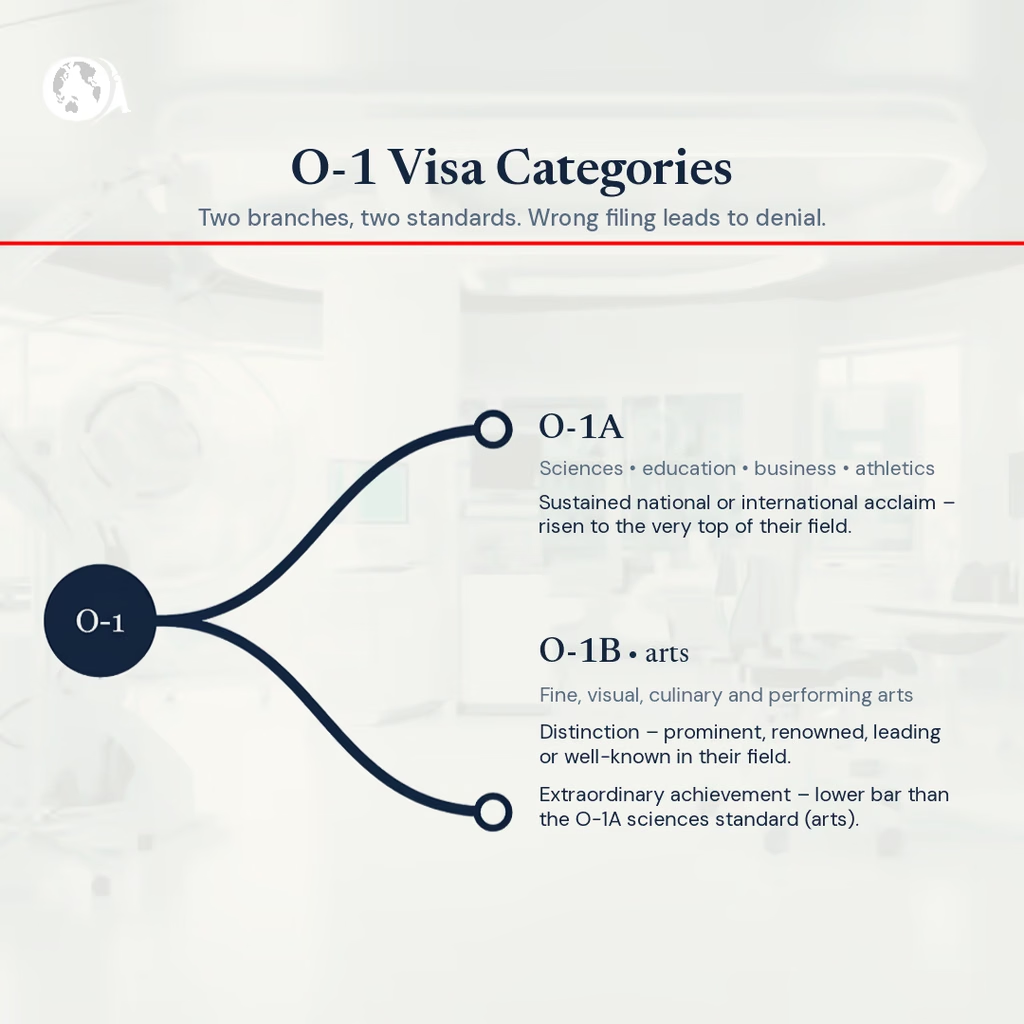
The O-1 family includes four visa types: O-1A, O-1B, O-2, and O-3.
O-1A covers sciences, education, business, and athletics. The standard is sustained national or international acclaim: you must have risen to the very top of your field.
O-1B covers two distinct categories with different standards. An O-1B in the arts must demonstrate a “distinction” (being prominent, renowned, leading, or well-known in their field), a lower standard than the O-1A. Motion picture and television professionals, however, must show “extraordinary achievement” and sustained national or international acclaim.
Misclassifying O-1A versus O-1B is one of the most common petition errors attorneys see. An artist filing under O-1A criteria, or a scientist filing under O-1B, creates immediate grounds for denial.
O-2 holders accompany O-1 artists or athletes. They must provide assistance that is an integral part of the performance and requires critical skills a U.S. worker cannot readily perform.
O-3 visas are for spouses and unmarried children under 21 of O visa holders.
O-1 Visa Requirements: The Three-of-Eight Evidentiary Standard
To qualify for an O-1 visa, you have two paths. The first is to win a single major internationally recognized award, such as a Nobel Prize, an Academy Award, or an Olympic medal. The second, more common path is to document at least three of the eight specific criteria defined by USCIS.
Meeting three criteria alone does not guarantee approval, as a USCIS officer also makes a subjective final determination on whether your evidence demonstrates extraordinary ability.
The eight O-1A criteria apply to science, education, business, and athletics. O-1B has a parallel set for individuals in the arts and film/TV (see USCIS Policy Manual Volume 2, Part M).
Tech professionals consistently underestimate their O-1A eligibility because their credentials don’t resemble traditional academic achievements, but the criteria map directly to tech work.
| Criterion | Tech Example |
|---|---|
| 1. Major prizes or awards | Hackathon wins, IEEE awards, best paper awards |
| 2. Distinguished memberships | ACM Fellow, IEEE Senior Member |
| 3. Published material about you | TechCrunch, Wired, MIT Technology Review features |
| 4. Judging others’ work | NeurIPS reviewer, grant panel participation |
| 5. Original contributions | Approved patents, widely adopted open-source tools |
| 6. Scholarly authorship | Peer-reviewed papers, widely cited technical writing |
| 7. Critical role at distinguished org | Lead engineer at a top-tier tech company |
| 8. High remuneration | Above-market salary, equity packages |
USCIS applies nuances to the table above. Approved patents, not just applications, support criterion 5. For criterion 2, the association must require outstanding achievement, not just a fee.
Action Step: Audit your credentials against all eight criteria. Document every item with verifiable proof. Identify your three strongest before engaging an attorney.
Filing an O-1 Petition: Process, Timeline, Duration, and Extensions
You cannot file an O-1 visa petition yourself. A U.S. employer, U.S. agent, or foreign employer through a U.S. agent must file on your behalf using Form I-129 with the O-1 supplement.
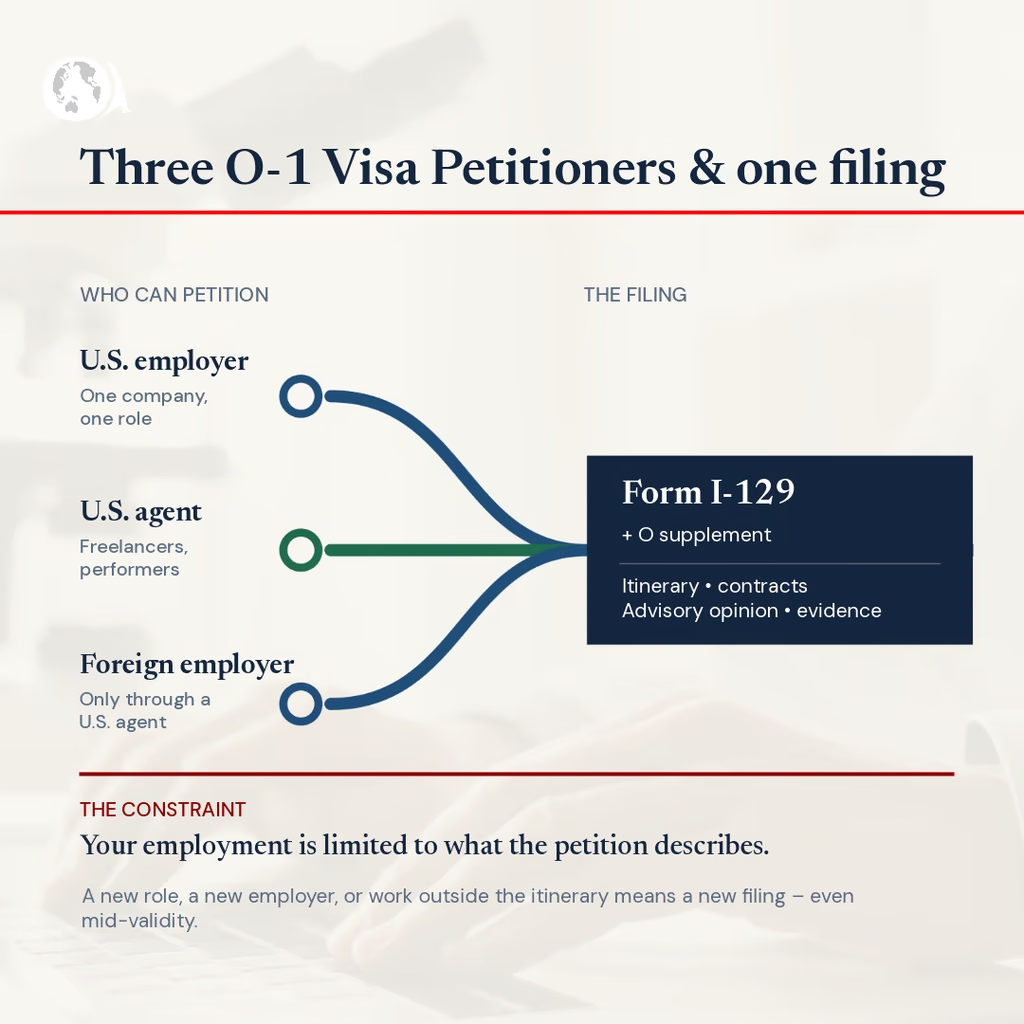
The package must include an itinerary of your proposed U.S. work, supporting contracts, evidence of past work, and an advisory letter from a U.S.-established expert in your field.
If you’re a freelancer, consultant, artist, or entrepreneur without a single employer, the agent petitioner model solves that. A U.S. agent can file one petition covering multiple engagements. This is common in the performing arts.
Extensions are granted one year at a time with no cap; O-1 holders can remain and file repeated extensions without time limitation if qualifying work continues.
| Stage | Typical Timeframe |
| Pre-filing preparation | 4–6 months |
| USCIS premium processing review | 15 business days |
| Approval document delivery | 7–14 days |
| Consular visa stamp (if abroad) | Add 2+ weeks |
| Initial approval period | Up to 3 years |
| Extensions | 3 years can be requested, but often 1 year is afforded |
The O-1 visa employment is restricted to what is described in the petition. Role changes likely require a new filing. Although family members can receive dependent visas, O-3 dependents (spouse and children under 21) receive no work authorization.
Action Step: If you’re self-employed or work across multiple clients, ask your immigration attorney about the agent petitioner structure before assuming you need a traditional employer sponsor.
Common O-1 Visa Denial Reasons and How to Avoid Them
Many O-1 petitions fail because the evidence does not meet USCIS’s legal standard.
A common weakness is recommendation letters that describe work in general terms. USCIS requires explicit comparison to others in the field at a national or international level. Letters that say “she is a talented researcher” without benchmarking her against peers carry almost no evidentiary weight. The letters must also show how the individual has sustained national or international acclaim.
Local press coverage does not satisfy the published material criterion. USCIS draws a hard line between regional and national recognition. A feature in a city newspaper is not equivalent to coverage in a major national trade publication.
Weak critical role evidence is another consistent problem. Claiming an essential capacity without a letter from the organization confirming the role’s significance gives officers nothing concrete to evaluate.
Meeting three O-1 visa criteria on paper isn’t enough. Thin documentation within a criterion fails even when the criterion technically applies.
Action Step: Before filing, have your attorney review every recommendation letter against the national or international recognition standard. Generic praise is not evidence. Comparative, field-specific language is.
O-1 in Context: How It Compares to H-1B and the EB-1A Green Card Path
The O-1 visa operates outside some constraints that define many work visas. For example, unlike H-1B visas, there is no annual cap and no lottery. It also has no prevailing wage requirement. For qualifying professionals, it’s a fundamentally different category.
| Feature | O-1 | H-1B |
| Annual cap | None | 85,000 per year |
| Lottery | No | Yes (most private employers) |
| Prevailing wage | Not required | Required |
| Premium processing | Always available | Not always available |
| Employer portability | New petition required before switching | Transfer allowed after filing |
These differences have a substantial impact on eligibility and timing.
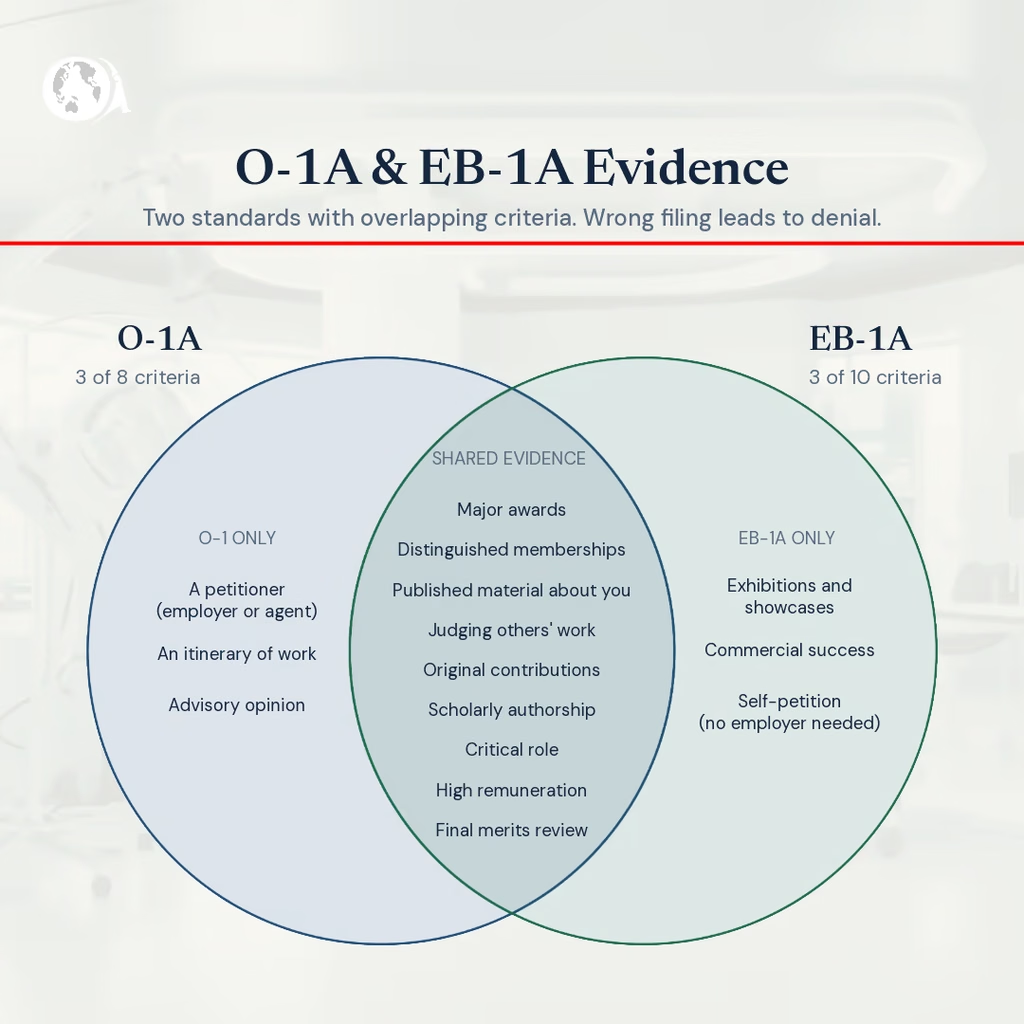
Also keep in mind the differences between the nonimmigrant O-1 category and the permanent residence EB-1A category. USCIS itself describes the O-1A evidentiary standard as similar to the EB-1A immigrant visa standard. The criteria overlap significantly. Evidence you build for an O-1A (awards, publications, salary documentation, critical role letters) can also be used to support an EB-1A petition.
Keep in mind, however, that an O-1 approval does not guarantee EB-1A approval. It does, however, signal that USCIS has already found your evidence supportable under a standard for extraordinary ability. The EB-1A requires no employer sponsorship, meaning you can self-petition, although the burden of proof for a self-petition is higher.
In our work with O-1 holders, a common missed opportunity is waiting too long to think about the EB-1A.
Action Step: Subject to the H-1B lottery? Evaluate whether your credentials meet the O-1A threshold. A single strong O-1 petition can replace years of lottery uncertainty.
Working With Oltarsh & Associates on Your O-1 Visa Petition
Oltarsh & Associates has practiced immigration law in New York City for decades. That matters because New York produces a specific kind of O-1 visa applicant: researchers at major medical centers, startup founders raising institutional capital, and artists and performers with international careers.
We know which evidence USCIS actually accepts for each population. And we build the case around that from day one.
Evidence strategy is where most petitions succeed or fail. We analyze your record against all eight criteria, identify the three to five strongest, and build the advisory-opinion and consultation record to support them. We don’t pad files; we make precise arguments.
When USCIS issues an RFE (a Request for Evidence), it almost always targets comparable-evidence substitutions or itinerary gaps. In our work with performers and artists, these are the two most common pressure points. We handle both as part of standard case management.
We also plan the O-1-to-EB-1A transition from the outset, not as an afterthought once you’re already in status. The documentation habits you build now either support or undermine a future green card petition.
Our practice is bilingual, serving New York’s international community in English and Spanish.
Action Step: Schedule a consultation to review which O-1 criteria your record already satisfies, and where the gaps are before USCIS finds them.
Frequently Asked Questions
What is an O-1 visa?
The O-1 visa is a U.S. nonimmigrant work visa for foreign nationals with extraordinary ability or achievement in their field. It covers two categories: O-1A for science, education, business, and athletics, and O-1B for arts, film, and television. Unlike most work visas, it has no annual cap and no lottery. You can apply any time of year, and it’s renewable indefinitely as long as you maintain qualifying work in the U.S.
Who qualifies for an O-1 visa?
You qualify by demonstrating extraordinary ability, meaning you rank among the top of your field, not just that you’re skilled. For O-1A, USCIS evaluates criteria like awards, high salary, critical roles, and published work. For O-1B, the bar includes lead roles, critical reception, and commercial success. You must meet at least three of the listed criteria, and your petition must include substantial documentary evidence for each.
Is O-1 better than H-1B?
The O-1 has meaningful advantages over the H-1B for the right candidate. There’s no annual cap, no lottery, and no requirement that your role fall under a “specialty occupation.” The filing fees are also substantially lower. You can also get faster processing with premium processing. The tradeoff: the O-1 standard is genuinely high, and not every skilled professional will qualify. If you’ve been passed over in the H-1B lottery multiple times, the O-1 is worth a serious evaluation with an immigration attorney.
How long does it take to get an O-1 visa?
Standard O-1 processing time through USCIS runs two to three months from filing to approval. Premium processing is available for an additional fee and guarantees a response within 15 business days, though that response may be a request for evidence, not an approval. Your employer or agent must file the petition before you can apply for the visa stamp at a U.S. consulate, which adds time depending on appointment availability.
Does an O-1 visa lead to a green card?
The O-1 visa does not automatically lead to a green card. Keep in mind that an O-1 has no immigrant intent, whereas a permanent residence application demonstrates immigrant intent. Still, it’s a viable path toward a green card. Many O-1 holders pursue EB-1A (Extraordinary Ability) or EB-1B (Outstanding Researcher) categories, which share similar evidentiary standards. Because the O-1 is nonimmigrant, you’ll need to demonstrate immigrant intent separately through a green card petition. Working with an attorney early helps you build a record that supports both.
What is the difference between O-1A and O-1B?
O-1A covers extraordinary ability in science, education, business, or athletics. O-1B covers extraordinary achievement in the arts, film, or television. The criteria differ: Although both O-1A and O-1B use a structured list of eight criteria, O-1B for the arts (excluding television and film) applies a lower standard of “distinction,” emphasizing recognition and prominence. Your field of work—not your preference—determines which category applies; misclassification could delay your case, but more likely result in denial.
Can I self-petition for an O-1 visa?
You cannot self-petition for an O-1 visa. Unlike the EB-1A green card, the O-1 requires a U.S. employer, agent, or sponsoring organization to file the petition on your behalf. If you’re a freelancer or work with multiple clients, a U.S.-based agent can file as your representative and structure your engagements under an itinerary. This is a common setup for artists, consultants, and independent professionals, but the agent must be a legitimate U.S. entity, not a foreign employer.
Do You Need Help With Your O-1 Visa?
Oltarsh & Associates, P.C. has guided professionals through O-1A and O-1B petitions across industries (from early-stage founders to established researchers), helping them build petition records that withstand USCIS scrutiny.
This article is provided for informational purposes only, and does not constitute legal advice nor does it create an attorney–client relationship with Oltarsh & Associates, P.C. or any of its lawyers, employees and/or agents. Laws and policies change, and information here may not reflect the most current legal developments. You can contact us about your specific situation.


 English
  Español