


On May 19, 2026, President Trump signed Executive Order 14406. The banking order that was reported as delayed back in March is now in effect.
Here is the part most coverage gets wrong. The order does not require your bank to verify your citizenship. There is no universal citizenship-verification mandate. What the order created is a risk-based system: your bank is not checking everyone, but certain patterns now trigger a closer look.
Your immigrant bank account rights still exist, and several have not changed at all. But the ground under them has moved. The honest answer is more complicated than “you’re protected.”
Here is what the order actually requires, what changed on June 5, and what to do about your account.
What You’ll Learn
- What Executive Order 14406 requires and the three things it does not require
- What the June 5 FinCEN advisory means when your bank sees an ITIN
- Why the rules for your checking account are different from the rules for a loan
- Which of your immigrant bank account rights are unchanged, stated plainly
- The New York protections that still apply when federal policy does not
- The two dates in the next four months that could change this again
What Executive Order 14406 Actually Requires
In March 2026, news outlets reported that a proposed banking order had been shelved after opposition from banks and community lenders. That reporting was accurate at the time, and it described an earlier draft.
The version signed on May 19. 2026 has important changes. What survived is a risk-based approach. In plain terms: banks may ask about immigration status when other warning signs are already present, not as a routine step for every customer.
The order itself says institutions keep “the authority” to obtain more information “where warranted by other risk indicators or supervisory concerns.” Authority is not the same as a requirement.
The order also set a schedule for federal agencies:
| Deadline | What is due |
|---|---|
| ~July 18, 2026 | Treasury advisory on red flags — issued June 5 |
| ~July 18, 2026 | Bank regulator guidance on credit risk — issued July 13 |
| ~August 17, 2026 | Treasury proposes Bank Secrecy Act due diligence changes |
| ~November 15, 2026 | Regulators consider rules on foreign consular ID cards |
The Bottom Line: The order is real, it is in effect, and it is being implemented on schedule. Although the new Advisory still does not require your bank to check where you were born, as that requirement was removed, there can still be follow-up inquires in certain cases.
What Changed on June 5: The FinCEN Advisory
On June 5, 2026, Treasury’s Financial Crimes Enforcement Network issued Advisory FIN-2026-A002. It was issued jointly with the FDIC, the OCC, and the National Credit Union Administration, in coordination with the IRS.
The advisory lists 18 red flag indicators. This detail matters: 8 of the 18 indicators relate to individual customers; the other 10 concern companies.
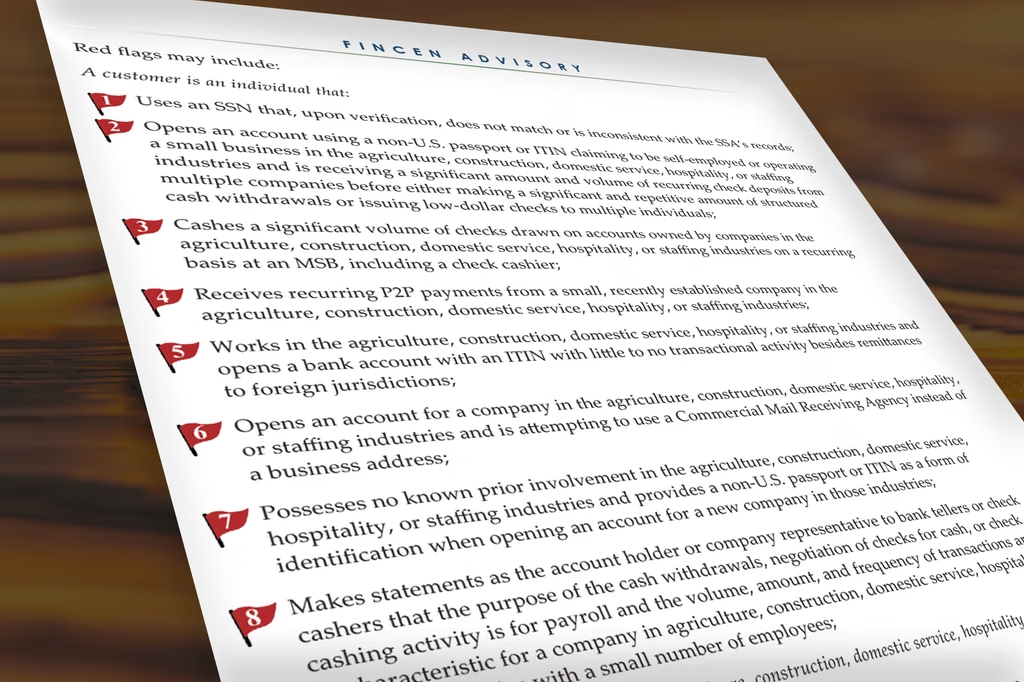
Most of the advisory targets employers, labor brokers, and shell companies running off-the-books payroll schemes. It is not aimed at people who deposit a paycheck and pay rent.
The advisory is also explicit on two points. No single red flag “should be taken in isolation.” And the indicators “do not convey or alter any independent regulatory obligations.”
What a SAR is, and what it is not
If a bank sees activity it considers suspicious, it files a Suspicious Activity Report (SAR) with FinCEN. FinCEN asked banks to tag these reports with the key term `FINANCIALINTEGRITY-2026-A002`.
A SAR is a confidential report to a Treasury bureau. It is not an immigration referral. Federal law, however, bars your bank from telling you if a SAR report has been filed.
Law enforcement agencies can access SAR data, and enforcement agencies, particularly DHS, have been using such data in their enforcement of the immigration laws. Indeed, the advisory separately encourages the public to report employers to ICE who hire unauthorized workers.
Action Step: If your bank contacts you asking for documents, write down exactly what was asked, who asked, and the date, before you respond to anything.
The ITIN Question, Answered Precisely
This is where getting it wrong may cause real harm.
ITINs are still valid for opening a bank account. Customer Identification Program rules require an identifying number, and a taxpayer identification number satisfies that rule. The advisory did not change this.
What changed is how banks are told to treat an ITIN number. The advisory says an ITIN used “in lieu of an SSN or valid employment authorization document” may be treated as “a risk factor requiring enhanced due diligence.”
Read that carefully. “Enhanced due diligence” means more questions.
Banks are told to weigh an ITIN “in light of the totality of other factors,” not on its own.
Only 1 out of 8 of the individual red flags enumerated involves an ordinary ITIN account. That advisement also requires work in a specific industry and an account with almost no activity besides money sent abroad.
Key Insight: The most damaging mistake is rarely the bank's question. It is the panicked answer. Closing accounts or moving money quickly creates exactly the pattern that the advisory tells banks to watch for.
Loans and Credit Follow Different Rules Than Your Checking Account
Two separate things happened this summer, and mixing them up causes unnecessary fear.
Your deposit account (checking and savings) is governed by the identity and anti-money-laundering rules.
Credit is now governed by something new. On June 8, 2026, the Consumer Financial Protection Bureau’s Statement on Ability to Repay and Immigration Status took effect. Under the Truth in Lending Act, it says lenders may be obligated to consider immigration status when deciding whether you can repay a mortgage or credit card.
The theory is blunt: if a lender’s records suggest you could be removed from the country, that bears on your future income.

Then on July 13, 2026, the FDIC, OCC and NCUA issued interagency guidance telling institutions to apply existing credit-risk practices to borrowers who are not work-authorized. The Federal Reserve had not issued matching guidance as of this writing.
Neither action tells a bank to close your checking account. Both are about lending.
The Bottom Line: Expect more friction on loan and credit card applications than on everyday banking. If you are applying for a mortgage this year, talk to an attorney before you file.
Your Immigrant Bank Account Rights That Have Not Changed
Immigrant bank account rights still hold true, but greater inspection of accounts may become the norm.
Identity verification is not citizenship verification. Customer Identification Program rules require your name, date of birth, address, and an identifying number. That number can be a Social Security Number or an ITIN. Nothing in these rules asks where you were born.
Your records still require legal process. Government agencies generally need a subpoena, court order, or other proper process to obtain your bank records. That is the Right to Financial Privacy Act.
Your money is still yours. If a bank closes your account for any reason, it must return your funds.
Lawful status is expressly carved out. The June advisory states in its own definitions that the population it targets does not include U.S. citizens, lawful permanent residents, or anyone whose employment is authorized by law.
If you hold a green card or work authorization, the advisory’s core subject matter is not you.
One practical note if your status has improved. You may have opened the account with an ITIN and subsequently received a Social Security Number. Your bank may still have only the ITIN on file, so updating that record is a small, sensible step.
Key Insight: Mixed-status households cause the most confusion. A joint account does not transfer one holder's immigration status to the other. A U.S. citizen spouse also does not shield an account from review, because each holder is assessed on their own information.
Can ICE freeze or take my bank account?
Not on the basis of immigration status alone.
Seizing money in a bank account is a forfeiture action. It generally requires a warrant or a forfeiture proceeding tied to suspected criminal activity, and it is a separate legal process from removal. Being detained does not itself freeze your account.
The “$3,000 bank rule” is not an immigration rule
This one causes real confusion, so here it is plainly.
Say you buy a money order or cashier’s check with cash, for an amount between $3,000 and $10,000. Under 31 CFR § 1010.415, the bank must verify your identity and keep a record for five years.
It is a recordkeeping rule about cash purchases; it applies to everyone, and it has been on the books for decades. It is not new, and it is not about immigration.
All reporting comes with heightened dangers for those foreign nationals without status. As a result of the record-sharing that is now occurring, bank-gathered information can be accessed by law enforcement, including the Department of Homeland Security. In addition, unprecedented fines are being administered against foreign nationals, including against individuals with orders of removal who do not leave the country, and fines for foreign nationals who entered the country without inspection. Bank account information obtained by the Department of Homeland Security, which previously was held in confidence, could now result in further action to collect such fines.
Extra Protections for Immigrant Bank Account Rights in New York
Your immigrant bank account rights are stronger in New York than in most of the country. This is the part readers elsewhere will not find.
New York bars credit discrimination on immigration status. Executive Law § 296-a makes it unlawful for a creditor to discriminate on a list of protected characteristics. That list expressly includes “citizenship or immigration status.”
That sits in real tension with the new federal guidance. The state law allows credit decisions based on “factually supportable, objective differences in applicants’ overall creditworthiness.” Federal regulators now say immigration status can bear on repayment ability.
Whether that federal reasoning fits inside New York’s exception has not been settled by a court. If you are a New York borrower who was denied, that unsettled question is exactly why the denial is worth reviewing.

New York City covers public accommodations. The NYC Human Rights Law prohibits discrimination based on actual or perceived alienage and citizenship status by providers of public accommodations in the city. The Commission on Human Rights has issued enforcement guidance on immigration status and national origin discrimination.
The Green Light Law survived its federal challenge. It limits DMV disclosure of your records to immigration authorities without a judicial warrant or court order. It also requires the DMV to notify you if a federal agency asks for your information. On December 23, 2025, a federal judge in the Northern District of New York dismissed the Justice Department’s challenge to it.
Action Step: If a New York bank denies you an account or credit, or asks for citizenship documents, save every letter and message and contact an immigration attorney. You may have a claim under city or state law that federal guidance does not erase.
What’s Coming Next
Two dates decide how much of this hardens into binding rules.
Around November 15, 2026, Treasury and the federal banking regulators are due to consider rule changes addressing foreign consular identification cards. If you bank using a consular ID, this is the date to watch.
In Congress, the Know Your American Customer Act (S. 4206) was introduced on March 25, 2026, and referred to the Senate Banking Committee. It would require verification of citizenship or lawful status for new accounts while grandfathering existing customers. It has not passed.
Separately, federal court orders have blocked IRS taxpayer data sharing with ICE under the 2025 agreement between the agencies. That litigation is active and on appeal, and the picture can change quickly, which is a reason to check the status of that fight rather than assume it.
Action Step: Put both dates in your calendar now. If you bank with an ITIN or a consular ID, check back in mid-August and mid-November rather than waiting to hear from your bank.
Frequently Asked Questions
Does the new executive order require my bank to check my citizenship?
No. Executive Order 14406 does not impose a universal citizenship-verification mandate. It confirms banks have authority to seek immigration status information where other risk indicators are already present. That is a risk-based approach, not a blanket rule. Your bank is not required to review every existing customer’s citizenship. Reporting from March 2026 described an earlier draft that would have required collection; that requirement is not in the signed order.
Can I still open a bank account with an ITIN?
Yes. An ITIN remains a valid identifying number under Customer Identification Program rules, and the June 2026 advisory did not prohibit ITIN accounts. It encourages banks to treat an ITIN used instead of a Social Security number as one risk factor among many. That can mean extra questions or document requests. Requirements still vary by institution, so it is worth calling ahead to confirm what a specific branch asks for.
Will my bank report me to immigration authorities?
Your bank may file a Suspicious Activity Report with FinCEN if it considers activity suspicious. It is legally barred from telling you if it does. A SAR is not itself an immigration referral, though law enforcement agencies can access that data. Separately, your actual bank records generally still require a subpoena or court order under the Right to Financial Privacy Act before a government agency can obtain them.
What should I do if my bank asks me for new documents?
Do not ignore the request, and do not answer it the same day. Write down exactly what was asked, who asked, and when. Then have an immigration attorney review it before you hand over anything. The bank may be doing routine due diligence rather than acting on a legal requirement. Providing documents you were not required to provide can create problems that are difficult to undo later.
Can my bank close my account because of my immigration status?
Banks retain broad discretion to close accounts, and that discretion existed before this order. What has changed is that regulators now encourage more scrutiny of certain patterns. That makes closures more likely, even without a rule requiring them. If your account is closed, the bank must return your funds. In New York, a closure or denial tied to immigration status may also raise claims under state or city law.
What happens to my bank account if I am detained or deported?
Your account does not close automatically, and the money in it remains yours. The practical problem is access. From detention or from abroad, you may be unable to manage the account, and inactivity can eventually trigger dormancy or closure under state law. This is why financial contingency planning matters — a trusted person with proper authority, such as a power of attorney, can act on your behalf. Set that up before you need it, not during a crisis.
Does closing my account protect me?
No, and it can make things worse. Closing an account does not erase your banking history, because institutions retain records for years under federal law. You also lose documentation that can support an immigration case, and you lose credit history. You may be pushed into cash-only transactions that are harder to prove. Sudden account closures and rapid movement of money also resemble the patterns the June advisory tells banks to watch for.
What to Do Next
The threat we wrote about in March has landed. Here is what actually helps now.
This week:
- Confirm what identification your bank has on file, especially if your status has changed since you opened the account
- If you rely on a single institution for everything, open a second account elsewhere
This month:
- Gather bank statements, tax returns and pay stubs, and store copies somewhere you can reach them quickly
- If you are planning a mortgage or major credit application, get advice before you apply — this is where the rules actually tightened
Ongoing:
- Read anything your bank sends you, and have unusual document requests reviewed before responding
- Watch the August and November dates above, and read our immigration enforcement update for the wider picture
Need Immigration Help?
Oltarsh & Associates has protected immigrants’ rights in New York for over 50 years. If your bank has asked for citizenship documents, denied you credit, or closed your account, that decision is worth reviewing before you accept it.
Call (212) 944-9420 or contact us for a free case evaluation.
This article is provided for informational purposes only, and does not constitute legal advice nor does it create an attorney–client relationship with Oltarsh & Associates, P.C. or any of its lawyers, employees and/or agents. Laws and policies change, and information here may not reflect the most current legal developments. You can contact us about your specific situation.



 English
  Español