

The United States allocates approximately 140,000 employment based green card visas each fiscal year across five preference categories. If you’re a foreign national working in the U.S. or planning to, this is your pathway to permanent residence.
Not all categories move at the same speed. An EB-1 petition for someone with extraordinary ability might process in under a year. An EB-2 or EB-3 application for a national of India, for example, could face a long wait, even after a positive adjudication, due to specific country limitations.
The category you choose determines whether you need labor certification, whether you can self-petition, and how long you will wait. According to the U.S. Bureau of Labor Statistics, approximately 17% of the American workforce is foreign-born. The employment-based system is the means to obtain permanent residence through a work-based system, sourcing those who have skills and talents absent from the US workforce, or individuals with extraordinarily recognized skills and talents, or a background needed in the US economy.
This guide covers all five categories, the PERM labor certification process, and the portability rules that protect your priority date when you change jobs.
EB-1 (Priority Workers) covers extraordinary ability, outstanding researchers, and multinational executives. All three EB-1 categories obviate the need for a labor certification, and extraordinary ability applicants can self-petition without an employer.
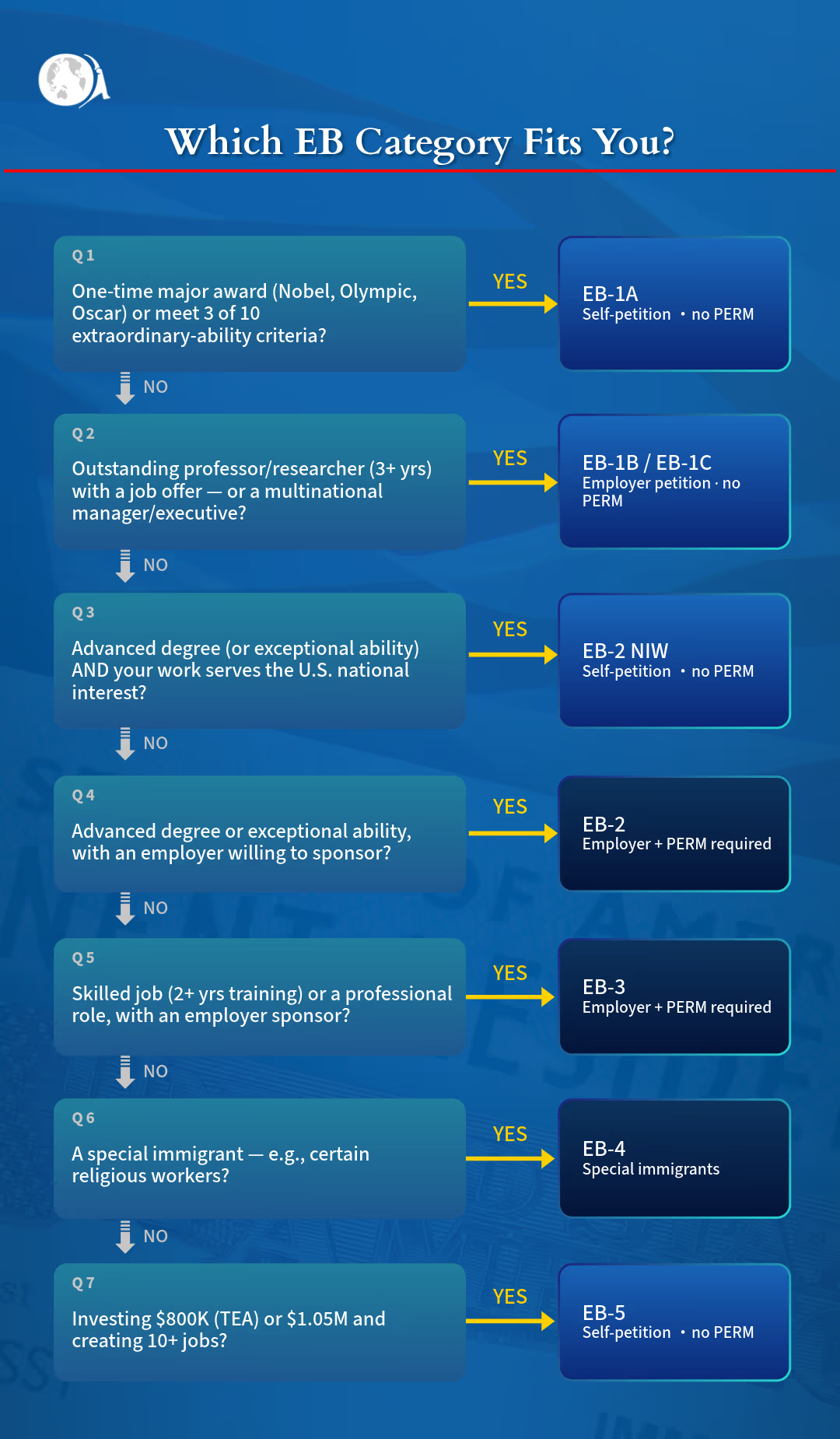
EB-2 (Advanced Degree or Exceptional Ability) typically requires a master’s or higher. The EB-2 National Interest Waiver (NIW) lets you self-petition and bypass labor certification. EB-3 (Skilled Workers and Professionals) has the broadest eligibility but the longest waits. EB-4 (Special Immigrants) serves specific groups, such as religious workers. EB-5 (Immigrant Investors) requires substantial capital investment.
| Category | Labor Cert Required | Self-Petition Option | Typical Wait |
|---|---|---|---|
| EB-1 | No | Yes (extraordinary ability only) | Current for most countries |
| EB-2 | Yes (except NIW) | Yes (NIW only) | Current to 3+ years (India/China: longer) |
| EB-3 | Yes | No | 1-3 years (India/China: 10+ years) |
| EB-4 | No | Varies | Current for most subcategories |
| EB-5 | No | Yes | Current to 2 years |
EB-1A lets you self-petition without employer sponsorship or labor certification. You must meet 3 of 10 criteria or show a one-time major internationally recognized achievement (such as a Pulitzer, Oscar, or Olympic Medal).
EB-1B requires an employer petition plus at least three years of research or teaching experience and international recognition. The employer must offer a tenure, tenure-track, or comparable research position.
EB-1C requires at least one year of managerial or executive work at an overseas affiliate within the preceding three years.
EB-2 NIW lets you self-petition if your work benefits U.S. national interest, waiving both job offer and labor certification. Standard EB-2 requires PERM. All EB-3 paths require employer sponsorship and PERM.
In our work with clients from India, we’ve seen applicants default to EB-3 when they qualify for EB-2 or even EB-1A. That single decision can add 5-7 years to the timeline. Choose based on your country’s wait times, not just eligibility.
PERM (Program Electronic Review Management) is the labor certification process filed with the U.S. Department of Labor. It’s required for standard EB-2 and all EB-3 petitions, but not for EB-1, EB-2 NIW, EB-4, or EB-5.
Your priority date is established when your employer submits the PERM application to the DOL, not when it’s approved.
| Phase | Duration | Notes |
|---|---|---|
| Prevailing wage determination | Filed with State Workforce Agency | Confirms wage for position |
| Recruitment period | 30-180 days before filing | All ads and recruitment steps must occur in this window |
| PERM processing | 6 months to over 1 year | After submission to DOL |
PERM is specific to the employer, position, duties, and geographic location. Changing any element requires a new PERM from scratch. All recruitment documentation must be maintained for at least five years from the filing date.
For professional positions, employers must complete at least three additional advertising methods beyond the standard requirements (job order for 30 days, on-site posting for 10 consecutive business days, and two Sunday newspaper editions). Denied cases are appealed to the Board of Alien Labor Certification Appeals.
Key Insight: If your employer is pursuing PERM, ask for the filing date immediately. That date becomes your priority date — the single most important date in your green card timeline.
Form I-140 is the immigrant petition filed with USCIS after PERM approval. Self-petitioners file their own for EB-1A and EB-2 NIW cases.

Your priority date, the PERM filing date, or the I-140 filing date, if no PERM is required, determines when you can file for your green card. The per-country cap means no single country receives more than 7% of the annual 140,000 employment-based visas.
If your approved I-140 remains valid for 180+ days before any withdrawal, you can port that priority date to a new employer.
| Country | EB-1 | EB-2 | EB-3 |
|---|---|---|---|
| India | 4-year delay (although this changes throughout the year) | 10+ years | 10+ years |
| China | 2 year delay (although this changes throughout the year) | 2-4 years | 3-5 years |
| All other countries | Current | Current | Current |
Backlogs fluctuate and often move backward during the summer months; at the new fiscal year commencing October 1, the numbers often move forward. Check the current Visa Bulletin for real-time status.
The Bottom Line: Once your I-140 is approved, request a copy of the approval notice. Track your priority date monthly via the Visa Bulletin.
Form I-485 is your application for lawful permanent residence. You file it when your priority date becomes current per the Department of State’s monthly Visa Bulletin.
You must meet all eligibility requirements and not be subject to a ground of inadmissibility. You must have been inspected and admitted or paroled into the U.S., physically present at the time of filing and in status, an immigrant visa immediately available at filing and at final decision, the job from your I-140 still exists, and you are admissible, meaning not subject to a ground of inadmissibility.
For EB-1 applicants from countries without backlogs, you can file I-485 concurrently with your I-140 if your priority date is already current.
Once your I-485 has been pending 180 days or more, you can change employers under Section 204(j) portability rules. Your new job must be in the same or a similar occupational classification. While pending, you can also apply for an Employment Authorization Document (EAD) and an Advance Parole travel document.
Key Insight: When your priority date becomes current, file immediately. Dates can retrogress within weeks. Have your I-485 package, birth certificates, passport copies, medical exam (Form I-693), tax returns ready before your date arrives.
In practice, employer changes are the most anxiety-producing part of this process. Your options depend entirely on timing.
| Timing | Can Change? | Priority Date | Requirements |
|---|---|---|---|
| Pre-I-140 approval | No. You must restart process | Lost (unless self-petition) | New PERM and I-140 |
| Post-I-140, pre-I-485 | No. You must restart process, but retain your priority date | Portable | New PERM and I-140 |
| I-485 pending 180+ days | Yes | Retained | Same/similar occupational classification |
| I-485 pending under 180 days | No | Retained | Typically withdraw and refile |
“Same or similar” is determined by job duties, not job title. Keep a copy of your I-140 approval notice to prove your priority date independently of your employer’s records.
Your spouse and unmarried children under 21 can qualify as derivative beneficiaries. They receive your priority date and visa category without separate employer sponsorship.
Derivative beneficiaries receive permanent residence in the same category as the principal applicant — all family members get green cards together. Your spouse can apply for an EAD immediately after filing Form I-485.
Children who turn 21 during the process may “age out.” The Child Status Protection Act (CSPA) freezes their age calculation: biological age when your priority date becomes current, minus the days your I-140 was pending.
Key Insight: If you have children approaching 21, calculate their CSPA age now. This single calculation determines whether they're protected or must file independently.
Choosing EB-3 when you qualify for EB-2 costs applicants from India and China 5-7 additional years. Many employers default to EB-3 because it requires less documentation. The category you select determines your wait time more than any other factor.

Not requesting a copy of your I-140receipt or approval will complicate your ability to port. Your case either has to be approved or pending for at least 180 days. Your documentation demonstrates that you satisfied the legal criteria. Get copies!
Changing employers before the 180-day mark after filing Form I-485 invalidates your adjustment of status. Section 204(j) portability only applies after 180 days pending.
Ignoring the monthly Visa Bulletin means missing your filing window, which can impact eligibility if the numbers move backward. Priority dates can advance suddenly, then retrogress within weeks.
Assuming your employer will initiate the process can be a substantial mistake. In our work with clients, we have seen a disconnect between employers and employees. It is best to be informed. Ask directly.
Employers must cover PERM and I-140 costs. Employees may pay I-485 expenses. PERM has no government filing fee, but legal and recruitment costs are applicable.
| Stage | Government Fee | Typical Legal Fee and Costs | Who Typically Pays |
|---|---|---|---|
| PERM | $0 | $7,500+ | Employer |
| Form I-140 | Check USCIS fee schedule | $2,000-$5,000 | Employer |
| Form I-485 (per person) | Check USCIS fee schedule | $2,000-$4,000 | Employee |
| Medical Exam (per person) | $200-$500 | N/A | Employee |
Hidden costs add up: credential evaluations ($100-$300) and certified translations ($20-$50 per page). Request confirmation from your employer about which costs they will cover.
Total processing time ranges from 12 months to over a decade, depending on your category and country of birth.
India-born EB-2 and EB-3 applicants face 10+ years after I-140 approval due to the 7% per-country cap.
| Category | Country | PERM | I-140 | Priority Date Wait | I-485 | Total |
|---|---|---|---|---|---|---|
| EB-1 | Worldwide – except India and China | Not required | 4-8 months | None | 8-18 months | 12-18 months |
| EB-2/EB-3 | Worldwide – except India and China | 12-18 months | 4-8 months | None | 8-18 months | 2-3 years |
| EB-2/EB-3 | India and China | 12-18 months | 4-8 months | 10+ years and 4 years, respectively | 8-18 months | 10+ years |
| EB-2 NIW | Worldwide, except India and China | Not required | 8-12 months | None | 8-18 months | 18-24 months |
The Bottom Line: If facing a 10+ year wait, evaluate whether upgrading to EB-1 or pursuing EB-2 NIW could significantly reduce the total time.
PERM labor certification alone is currently taking over 1 year. After PERM, you file Form I-140, then Form I-485. Total processing ranges from 12-18 months for EB-1 cases (which skip PERM) to 10+ years for EB-2 and EB-3 applicants from countries with visa backlogs.
Yes, but only in specific cases. EB-1A extraordinary ability applicants can self-petition without a job offer. You must meet 3 of 10 criteria or show a one-time major achievement. EB-2 NIW applicants can also self-petition. All other categories require employer sponsorship.
Under Section 204(j) of the Immigration and Nationality Act, your approved Form I-140 remains valid if your Form I-485 has been pending 180 days or more. You must show that your new job is in the same or a similar occupational classification.
EB-2 covers professionals holding advanced degrees or persons of exceptional ability. EB-3 covers skilled workers, professionals, and other workers. EB-2 typically has shorter wait times as a higher preference category. Both require PERM in most cases.
Yes. After filing Form I-485, your spouse can apply for an EAD as a derivative beneficiary. The EAD allows work for any employer while your application remains pending.
Your priority date is established when PERM is submitted to the DOL (or when I-140 is filed if no PERM is required). It determines your place in line for one of the approximately 140,000 annual employment-based visas. Track availability through the monthly Visa Bulletin.
This week:
This month:
Ongoing:
This article is provided for informational purposes only, and does not constitute legal advice nor does it create an attorney–client relationship with Oltarsh & Associates, P.C. or any of its lawyers, employees and/or agents. Laws and policies change, and information here may not reflect the most current legal developments. You can contact us about your specific situation.
 English English
  Español
