

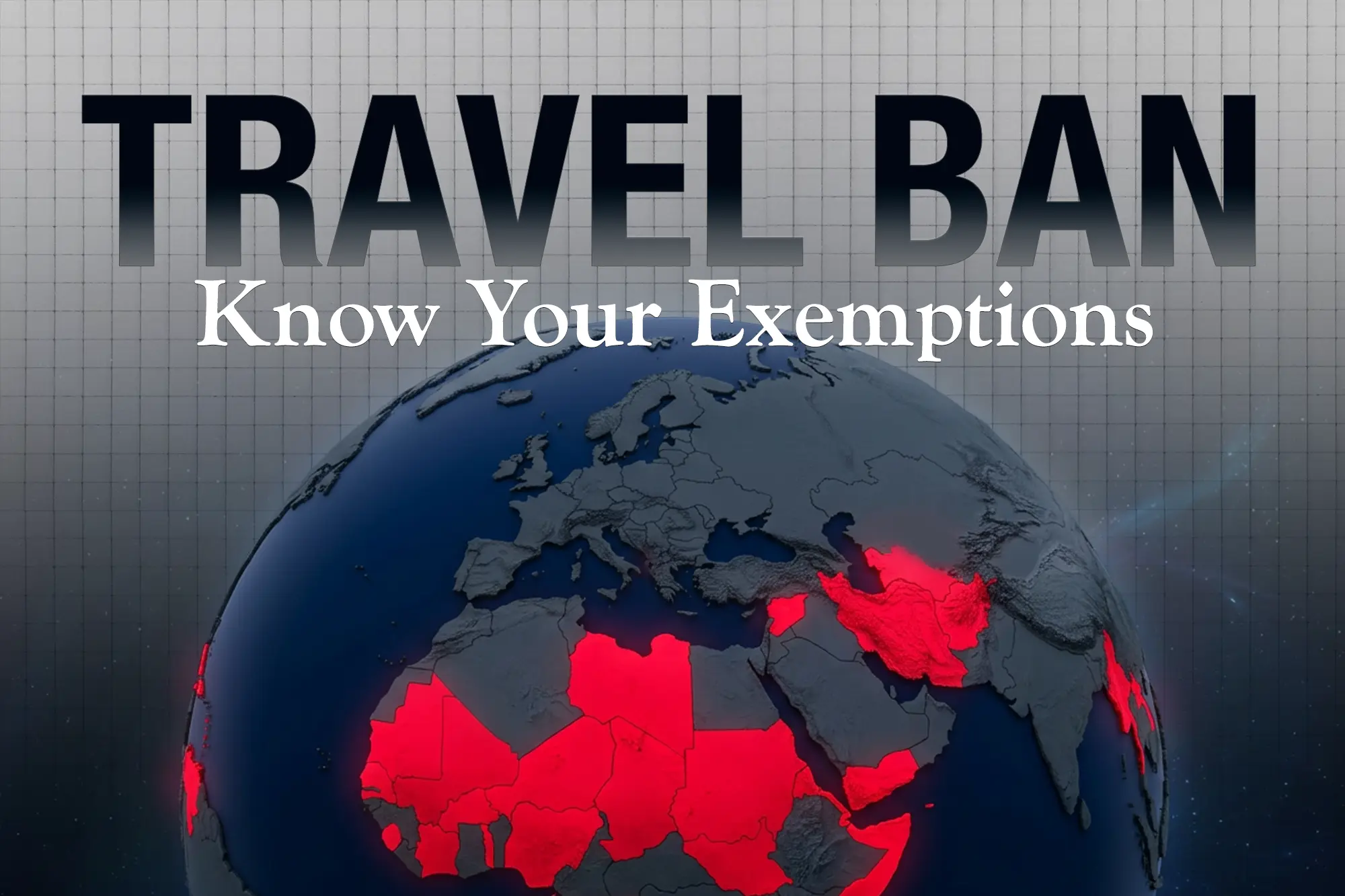
The 2025 travel ban, which expands and slightly modifies an earlier ban, took effect on January 1, 2026, and now affects foreign nationals from 75 countries. Certain travel ban exemptions apply to this broad U.S. travel and immigration restriction.
If you or a family member is from an affected country, you should not assume all doors are closed—you may still qualify for travel ban exemptions or a waiver.
This guide explains who qualifies for travel ban exemptions, how to pursue a national interest waiver, and what steps to take right now.
What You’ll Learn
- Who qualifies for travel ban exemptions (you may already be eligible)
- How to apply for a national interest waiver
- Which visa categories are still available for the banned countries
- Immediate steps to protect pending applications
- When to contact an immigration attorney
Travel Ban Exemptions in 2026: Who Qualifies
Not everyone from the banned countries is blocked. Several travel ban exemptions apply automatically.
The following groups qualify for travel ban exemptions, meaning the ban does not apply to these individuals:
| Exempt Category | Details |
|---|---|
| Green card holders | Lawful permanent residents can still travel and return |
| Valid visa holders | If you already have an approved visa, it remains valid |
| Diplomats | A-1 and A-2 visa holders are exempt |
| Certain athletes/performers | Specific visa categories for international events |
| National interest exceptions | Case-by-case determination (see below) |
If you fall into one of these categories, you qualify for travel ban exemptions.
However, if you’re a green card holder from a banned country, consult an immigration attorney before traveling internationally. Processing delays and secondary screening are common.
National Interest Waiver: The Primary Path for Travel Ban Exemptions
The national interest waiver is the primary pathway for individuals who don’t qualify for automatic travel ban exemptions.
This waiver allows entry when the U.S. government determines that admitting the foreign national from the banned country serves the United States’ interests.
Who May Qualify for a National Interest Waiver
- Professionals with specialized skills in demand
- Researchers and academics in critical fields
- Individuals with significant business ties to U.S. companies
- Family reunification cases involving U.S. citizens
- Medical professionals and healthcare workers
- Those with urgent humanitarian circumstances
How to Apply
There is no stand-alone application form for the national interest exception.
The determination is made during your visa interview or upon review of your case by a consular officer.
To strengthen your case:
- Document your ties to U.S. interests (employer letters, contracts, research affiliations)
- Gather evidence of your specialized skills or unique qualifications
- Prepare supporting letters from U.S.-based organizations
- Work with an immigration attorney to frame your petition
Pro tip: National interest exceptions are discretionary. The quality of your documentation matters enormously. A well-prepared case with strong supporting evidence has significantly better odds than a bare application.

Which Visa Categories Are Still Processing
The ban affects both immigrant and non-immigrant visas—but not all categories equally.
Full Ban Countries
For countries facing full travel bans, most visa categories are suspended indefinitely.
Exceptions may still be granted for:
- Diplomatic visas (A category)
- International organization visas (G category)
- NATO visas
- Select exchange programs deemed in the national interest
Partial Ban Countries
Partial ban countries face restrictions on specific visa categories, while others remain open.
If your country is on the partial ban list, determine exactly which visa categories are affected before assuming you’re blocked.
An immigration attorney can review your specific situation and identify available options.
Immediate Steps If You’re Affected
This week:
- Determine your country’s status (full ban vs. partial restrictions)
- Identify whether any exemptions apply to you
- Gather all immigration documents and application records
- Schedule a consultation with an immigration attorney
If you have a pending application:
- Do not assume it’s automatically denied—contact your attorney immediately
- Document your current status and any communications from USCIS or the consulate
- Preserve evidence of ties to the U.S. (employment, family, property)
If you’re currently in the U.S.:
- Review your current status and expiration dates
- Consider whether adjustment of status or extension applications make sense
- Avoid international travel until you understand re-entry implications
In short: Travel ban exemptions exist—don't assume all doors are closed. Many people have options they don't realize. The first step is understanding exactly how the restrictions apply to your specific situation.
Countries Affected by the 2026 Travel Ban
The travel ban now covers 75 countries with varying levels of restriction.
Full Travel Ban Countries
These countries face a complete suspension of immigrant and most non-immigrant visa processing:
| Country | When Added |
|---|---|
| Afghanistan | Previously banned |
| Myanmar | Previously banned |
| Chad | Previously banned |
| Republic of Congo | Previously banned |
| Equatorial Guinea | Previously banned |
| Eritrea | Previously banned |
| Haiti | Previously banned |
| Iran | Previously banned |
| Libya | Previously banned |
| Somalia | Previously banned |
| Sudan | Previously banned |
| Yemen | Previously banned |
| Burkina Faso | January 2026 |
| Laos | January 2026 |
| Mali | January 2026 |
| Niger | January 2026 |
| Sierra Leone | January 2026 |
| South Sudan | January 2026 |
| Syria | January 2026 |
| Palestinian Authority | January 2026 |
Partial Restriction Countries
These countries face restrictions on specific visa categories:
| Newly Added (Jan 2026) | Previously Restricted |
|---|---|
| Angola | Burundi |
| Antigua and Barbuda | Cuba |
| Benin | Togo |
| Cote d’Ivoire | Turkmenistan |
| Dominica | Venezuela |
| Gabon | |
| The Gambia | |
| Malawi | |
| Mauritania | |
| Nigeria | |
| Senegal | |
| Tanzania | |
| Tonga | |
| Zambia | |
| Zimbabwe |
Historical Context: How We Got Here
It is difficult for many Americans to imagine, but before World War I, immigration into the U.S. was basically unrestricted—except for Chinese and other Asians.
Two decades after the turn of the 20th century, passports were still relatively new for international travel, born after the Great War.
At that time, there were no visas, no quotas, no green cards.
Inspection into the U.S. was cursory. A bare 2 percent of those arriving at Ellis Island during its peak decades were turned away.

The Exception: Asian Exclusion
A large exception to the general open policies for entry was the Chinese Exclusion Act of 1882. This was the first significant US law to exclude individuals from entering the United States based on nationality and deny citizenship. The Act signified a sea change in policy, establishing precedent to restrict foreign nationals based on ethnicity. This unfortunate part of U.S. history, which banned people based on their country of origin, is now being resurrected in these current bans.
The Immigration Act of 1924
Following nationalistic sentiment, the Immigration Act of 1924 introduced a new restrictive system within immigration based on nationality. It initiated numerical limits and country-of-nationality quotas.
This was not unprecedented in its restrictive nature. Since 1882, Congress had imposed qualitative exclusions on persons deemed likely to become public charges, morally or physically deficient, or bars for persons from Asian countries.
The Repeal
The Act was repealed in 1943 during a time when China was allied with the United States during WWII. The principle of racial desirability was formally repealed in U.S. immigration law in 1965 during the civil rights period of US history.
The Chinese Exclusion Act left a sad legacy that included institutionally accepted racism, family separation, and restrictive immigration policies. These unfortunate legacies clearly continue to impact immigration policy today, and the current ban has its basis in thought and precedent on these old policies.
Indeed, these current bans follow an ignoble history of discrimination in prior law, while ignoring the enormous benefit that foreign nationals have brought to this country.
Prior to the repeal, the bans were often fought in court. That fight against ill-conceived nationalistic policies continues today, with advocates bringing legal challenges to these new rules.
Why These Bans Face Legal Challenges
These policies exist in tension with established U.S. law—and with decades of immigration precedent.

Title VII of the Civil Rights Act of 1964
Federal law prohibits discrimination in hiring, promotion, discharge, pay, fringe benefits, job training, classification, referral, and other aspects of employment on the basis of race, color, or national origin.
The Immigration and Nationality Act
The INA itself prohibits employers from discriminating against U.S. citizens, U.S. nationals, and authorized aliens when hiring, discharging, or recruiting.
It also prohibits citizenship status discrimination against permanent residents, temporary residents, who have gone through the legalization program, refugees, and asylees.
The Disconnect With Recent Precedent
These new policies contradict how the U.S. has treated immigrants in the comparatively recent past.
From the turn of the last century through the 1960s, millions of predominantly European immigrants entered the country unlawfully—but they were met with almost no threat of arrest or deportation.
Migrants who entered illegally before the 1940s were protected from deportation by statutes of limitations and were given amnesty.
Prior to 1976, the U.S. government rarely deported parents of U.S. citizens.
Restrictions on public benefits did not exist prior to the 1970s.
Only in 1986 did it become illegal to hire an undocumented immigrant.
The underlying motivation for these new policies rests on the view that certain nationalities of immigrants are not helpful to the United States. These policies will no doubt be challenged in court.
They create unprecedented family separations, restrict long-standing pathways to lawful immigration, and ultimately undermine the innovation and hard work that have created strong U.S. economic growth.
They also undercut what should be a fair system—and impact exactly whom Trump claims should be assisted: people who do things the correct way and wait in line.
The Economic Cost of These Policies
The White House’s growing travel ban—shutting down immigrant visa processing indefinitely for 75 countries—returns to an unhappy history of nationalism and turns its back on the exceptionalism of the United States.
More than half of America’s most valuable tech companies were founded by first or second-generation immigrants, driving $8.6 trillion of revenue to the United States.
Among the founders who are immigrants themselves or children of immigrants—all of whom would be barred under current policies because of their or their parents’ country of nationality:
| Founder | Company | Country of Origin |
|---|---|---|
| Steve Jobs | Apple | Syria |
| Sergei Brin | Russia | |
| Eduardo Saverin | Meta | Brazil |
| Jeff Bezos | Amazon | Cuba |
| Ali Ghodsi, Arsalan Tavakoli-Shiraji, Matei Zaharia | Databricks | Iran |
These founders—or their parents—would have been barred from entering the country under these policies.
The Irony
The irony extends to President Trump’s own “Board of Peace,” in which nearly half of the countries represented are banned from entering the U.S. under his travel ban.
Frequently Asked Questions About Travel Ban Exemptions
It depends on whether your country faces full or partial restrictions, and which visa category you need. Full ban countries have most categories suspended, but travel ban exemptions exist. Partial ban countries may still process certain visa types. An immigration attorney can identify your specific options.
No. Lawful permanent residents are exempt. However, expect potential delays and secondary screening when re-entering the U.S. Consult an attorney before international travel.
A national interest waiver allows entry when admitting you serves U.S. interests. There’s no separate application—the determination is made during your visa process. Strong documentation of your value to U.S. interests improves your chances significantly.
Pending applications are handled case-by-case. Contact an immigration attorney immediately to understand your options. Do not assume automatic denial.
Family-based immigration from full ban countries is suspended, but national interest exceptions may apply to compelling family reunification cases. Consult with an attorney to evaluate your specific situation.
The suspension is indefinite. There is no announced timeline for review or expiration. Monitor official government sources for policy changes.
If you’re from an affected country and have any immigration goals involving the U.S., yes. An experienced attorney can identify exemptions, prepare waiver documentation, and navigate the evolving policy landscape.
How Oltarsh & Associates Can Help With Travel Ban Exemptions
These restrictions are complex. Travel ban exemptions and waivers are real—but navigating them requires experienced legal guidance.
At Oltarsh & Associates, we’ve helped clients through every major immigration policy shift, from previous travel bans to changing enforcement priorities.
If you’re affected, we can:
- Evaluate whether exemptions apply to your case
- Prepare documentation for national interest waiver requests
- Identify alternative immigration pathways
- Monitor and respond to changes in your pending applications
- Advise on timing and strategy as policies evolve
Don’t assume the door is closed. Many of our clients have found pathways they didn’t know existed.
This article is provided for informational purposes only, and does not constitute legal advice nor does it create an attorney–client relationship with Oltarsh & Associates, P.C. or any of its lawyers, employees and/or agents. Laws and policies change, and information here may not reflect the most current legal developments. You can contact us about your specific situation.


 English
  Español