



Federal agents in dark masks and bulletproof vests have become a common sight in American cities. Immigration enforcement in 2026 looks very different from what most Americans grew up with, and those changes now reach deep into ordinary neighborhoods and daily life.
These aren’t border scenes. They’re happening in Minneapolis, Chicago, and Los Angeles.
Two U.S. citizens have been fatally shot by federal immigration agents in Minnesota in January 2026 alone. The Trump administration’s immigration crackdown has brought border enforcement tactics into the interior of the United States—fundamentally changing how federal agents operate in American neighborhoods.
This isn’t just about immigration policy anymore.
It’s about your constitutional rights—whether you’re a citizen, a green card holder, or undocumented.
If you or someone you know could be affected by these enforcement changes, understanding your rights has never been more important.
What You’ll Learn
- How ICE and Border Patrol’s roles have merged—and why the tactics are more aggressive
- What the May 2025 ICE memo claims about entering homes without judicial warrants
- The critical difference between administrative and judicial warrants
- How states like New York are limiting cooperation with federal enforcement
- When you should—and shouldn’t—open your door to immigration agents
- What to do if you’re stopped or approached by ICE or Border Patrol
Two Agencies, One Mission: Understanding ICE vs. CBP
ICE (U.S. Immigration and Customs Enforcement) is the agency historically responsible for immigration enforcement inside the United States.
CBP (U.S. Customs and Border Protection), which includes Border Patrol, handles border security.
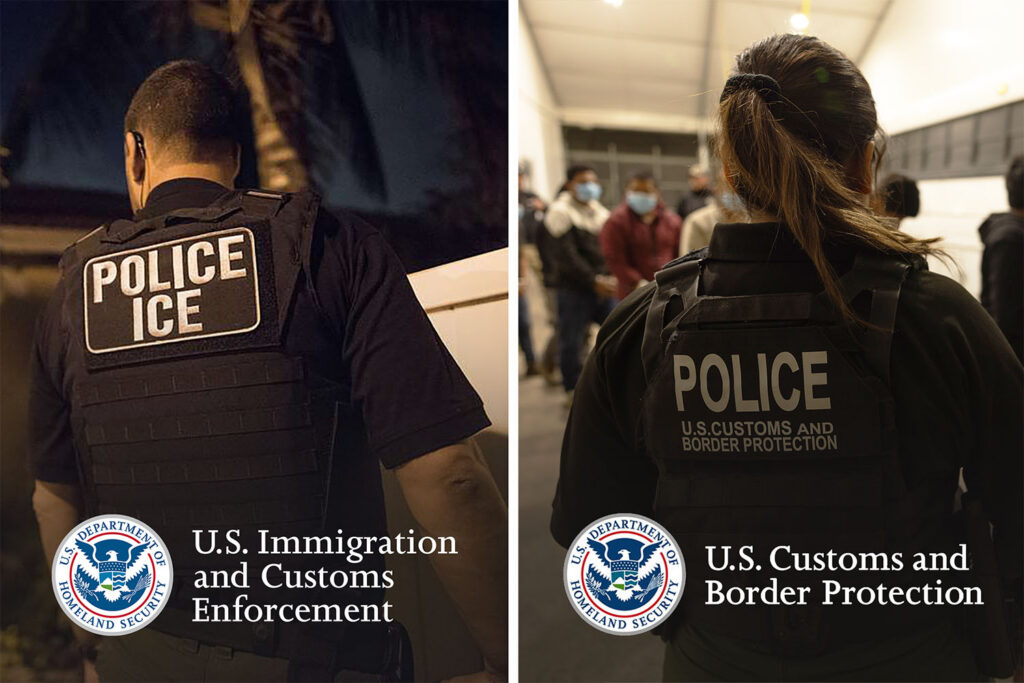
Both fall under the Department of Homeland Security, created after September 11, 2001. But they’ve always operated with distinct mandates and training.
| Agency | Traditional Role | Current Budget |
|---|---|---|
| ICE | Interior immigration enforcement | ~$10 billion |
| CBP | Border security and ports of entry | $18.3+ billion |
The distinction matters because CBP agents are trained for higher-threat border environments—including encounters with drug cartels and armed smugglers.
That training shapes their approach to every situation.
The Leadership Merger
In October 2025, at least 12 of ICE’s 25 field office directors were reassigned. Half were replaced by current or retired CBP officers.
This wasn’t just a personnel shuffle. It was a cultural shift.
Border Patrol commander Gregory Bovino—who previously led controversial operations in Chicago and Los Angeles—commanded operations in Minneapolis until his departure on January 27, 2026.
In short: The mentality and tactics designed for dangerous border encounters are now being applied to immigration enforcement in residential neighborhoods, schools, and workplaces.
The May 2025 ICE Memo: A Seismic Shift on Home Entry
A May 2025 internal ICE memo, revealed by whistleblowers in January 2026, claims officers can forcibly enter homes without a judicial warrant (NBC News).
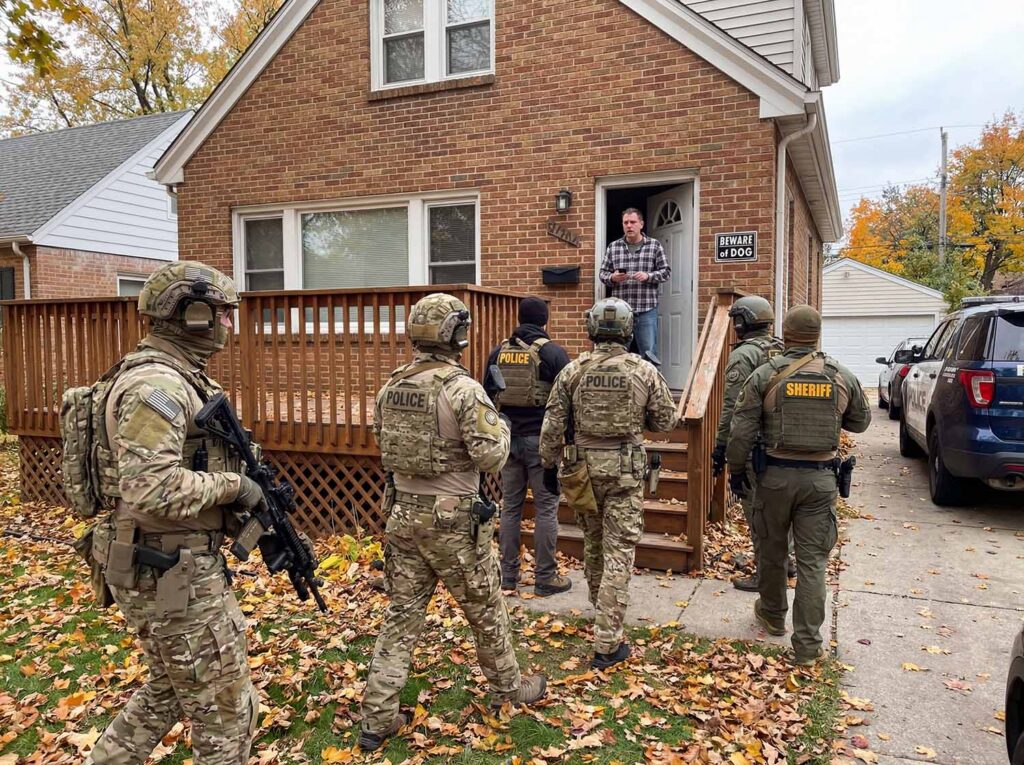
This contradicts decades of constitutional interpretation.
The memo is a centerpiece of immigration enforcement in 2026 because it attempts to normalize home entry based only on administrative paperwork instead of a judge’s warrant.
Two Types of Warrants—One Critical Difference
| Warrant Type | Who Signs It | What It Authorizes |
|---|---|---|
| Administrative Warrant (I-200/I-205) | ICE official | Arrest of person with removal order |
| Judicial Warrant | Federal judge or magistrate | Entry into home based on probable cause |
The Fourth Amendment has long been interpreted to require a judicial warrant for law enforcement to enter a home.
Under longstanding constitutional interpretation, you don’t need to open your door unless an officer has a warrant signed by a judge.
What the Memo Claims
The memo, signed by Acting ICE Director Todd Lyons, states:
“Although the U.S. Department of Homeland Security has not historically relied on administrative warrants alone to arrest aliens subject to final orders of removal in their place of residence, the DHS Office of General Counsel has recently determined that the U.S. Constitution… do[es] not prohibit relying on administrative warrants for this purpose.”
DHS’s own training materials have previously stated the opposite—that administrative warrants do not authorize home entry (Whistleblower Aid complaint).
This policy will face legal challenges. But until courts rule, the ICE Memo claims that they can enter homes with only an administrative warrant.
Pro Tip: If agents come to your door, ask to see the warrant through a window or ask that it be slipped under the door. Look for a judge’s signature—not just an ICE official’s signature. If it’s only signed by an ICE official, you are not legally required to open your door. Contact an immigration attorney immediately.
The 100-Mile “Border Zone”: Expanded Authority
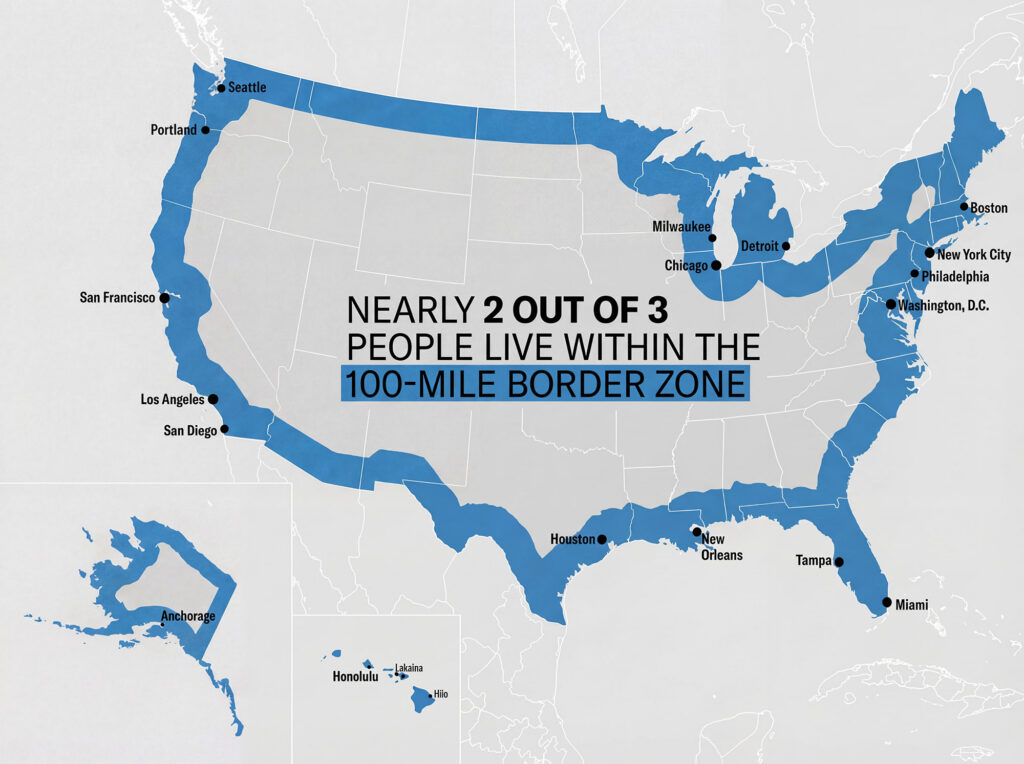
CBP claims authority to conduct warrantless searches “within a reasonable distance” of any U.S. border.
That distance is defined as 100 miles—including coastlines.
This means approximately two-thirds of the U.S. population lives within this zone (ACLU).
| City | Within 100-Mile Zone? |
|---|---|
| Seattle | Yes (Canada border + coast) |
| Portland | Yes (coast) |
| New York City | Yes (coast) |
| Los Angeles | Yes (coast + Mexico) |
| Chicago | No |
| Minneapolis | No |
For people living in or near this zone, immigration enforcement in 2026 no longer feels confined to border crossings—it follows them on highways, at bus stations, and even in small towns.
Even outside this zone, CBP agents are now participating in interior enforcement operations alongside ICE—as seen in Minneapolis.
What This Means for You
Within the 100-mile zone:
- CBP can operate immigration checkpoints
- Agents can stop vehicles with “reasonable suspicion” of an immigration violation
- But they still cannot search vehicles without “probable cause” or a warrant
The Supreme Court ruled in United States v. Brignoni-Ponce (1975) that ethnic appearance can be one factor in forming reasonable suspicion—but cannot be the sole basis for a stop.
How States Are Fighting Back
The Tenth Amendment limits federal power to compel state action.
The federal government cannot force states to “enact or administer a federal regulatory program” or commandeer state employees for federal enforcement.
This means states can choose whether to cooperate with ICE.
New York’s Position
New York Attorney General Letitia James has issued clear guidance for law enforcement.

Key principles:
- It’s not a crime for an undocumented individual to remain in the United States
- Undocumented individuals have constitutional rights under both state and federal law
- Local law enforcement cannot detain people at ICE’s request without a judicial warrant, except under limited circumstances
- An administrative warrant or detainer alone is not sufficient to enter a private area or home—it is not a judicial warrant and does not provide probable cause
What This Means Practically
In New York, state and local law enforcement:
- Cannot arrest and detain individuals for civil immigration violations alone
- Cannot rely on ICE administrative warrants or detainers
- Must have independent probable cause that an individual committed a crime
The words “probable cause” on an ICE form don’t create actual probable cause.
That determination requires examination of all facts and circumstances—not just the language chosen by federal immigration authorities.
Pro Tip: Know your state’s position on immigration enforcement cooperation. States like New York, California, and Illinois have “sanctuary” policies limiting local cooperation with ICE. Other states actively cooperate. Your state attorney general’s website will have current guidance.
What’s Happening in Minnesota: A Case Study
Minneapolis has become the epicenter of immigration enforcement controversy.
In December 2025, DHS announced “Operation Metro Surge”—deploying 2,000+ federal agents to the Twin Cities. Two U.S. citizens have been fatally shot by federal agents in January 2026:
- Renee Good (January 7, 2026): Shot by ICE agent while in her car
- Alex Pretti (January 24, 2026): An ICU nurse, shot by Border Patrol agents during a protest
Minnesota officials have filed suit against DHS, and a federal judge found ICE violated at least 96 court orders in Minnesota since January 1, 2026 alone.
This level of enforcement—and the resulting confrontations—demonstrates why understanding your rights is critical.
Frequently Asked Questions
No—unless they have a judicial warrant signed by a judge. An administrative warrant (Form I-200 or I-205) signed by an ICE official does not give agents the legal authority to enter your home under traditional constitutional interpretation. You can ask to see the warrant through a window or have it slipped under the door without opening it. The May 2025 ICE memo claims otherwise, but this is being challenged.
ICE historically handles interior immigration enforcement. Border Patrol (part of CBP) handles border security. However, these roles have merged significantly under the current administration, with Border Patrol agents now participating in interior enforcement operations and taking leadership positions at ICE.
CBP claims expanded authority within 100 miles of any U.S. border, including coastlines. This encompasses roughly two-thirds of the U.S. population. However, this claimed authority doesn’t eliminate Fourth Amendment protections—it expands where CBP asserts it can operate with reduced restrictions.
No. The Tenth Amendment prevents the federal government from compelling states to administer federal programs. States can choose whether to cooperate. Some states have “sanctuary” policies limiting cooperation; others actively assist federal enforcement.
You have the right to remain silent. You don’t have to answer questions about your immigration status, birthplace, or how you entered the U.S. Clearly stating “I am exercising my right to remain silent” is advisable. If you choose to speak, do not make a misstatement about your status. You can also ask if you’re free to leave. Carry your immigration documents if you have them, but you are not required to show them to anyone other than immigration officers.
Yes. U.S. citizens have been detained during immigration operations, including in Minnesota. Two U.S. citizens have been fatally shot by federal agents in Minneapolis in January 2026. Additionally, mixed-status families face unique challenges when a family member is targeted for enforcement.
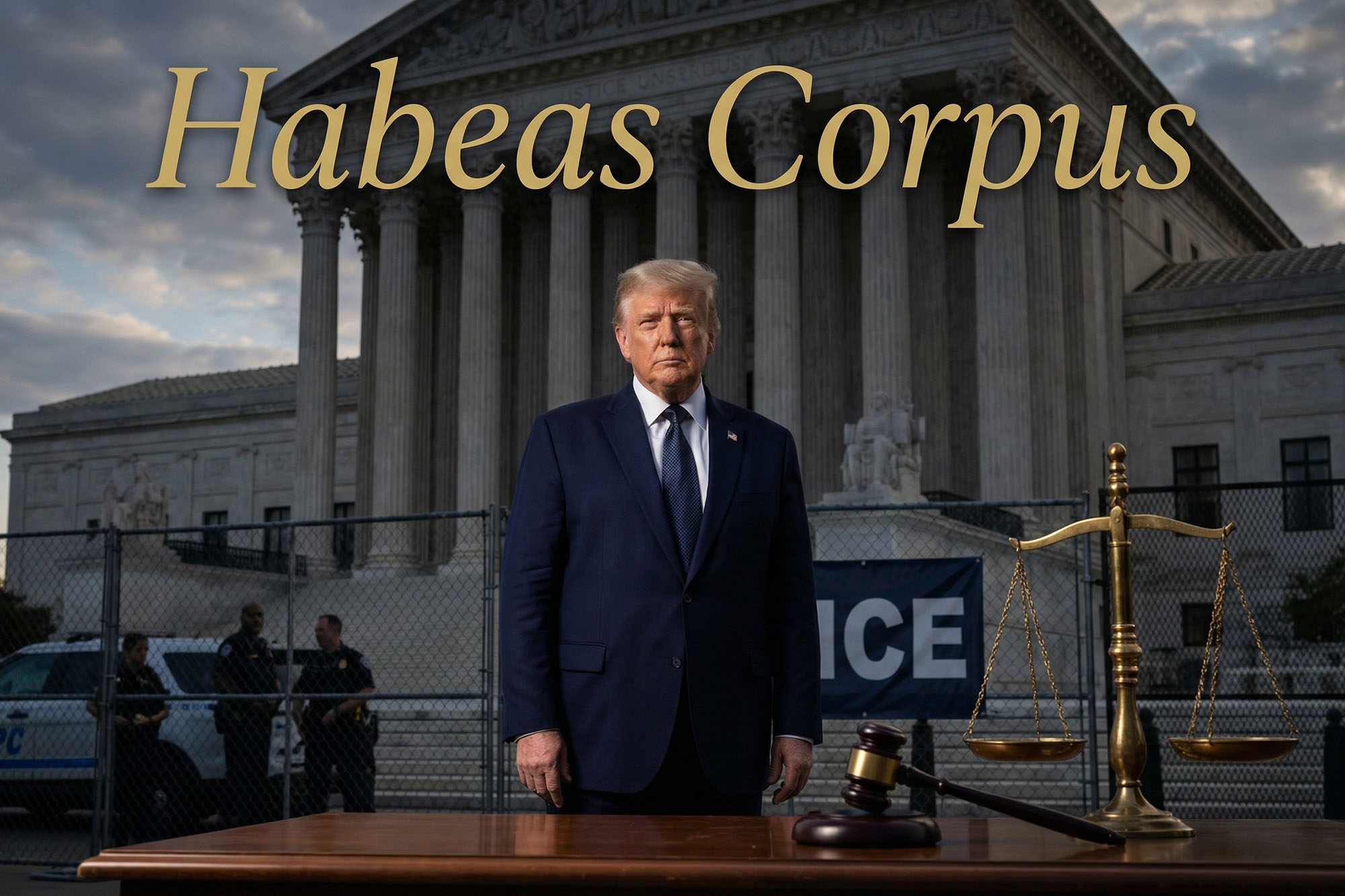
If you are detained by Immigration authorities, try to have family or friends contact an attorney immediately. Many Federal Courts are overturning immigration arrests and detention as unconstitutional through habeas corpus proceedings.
What to Do Next
This week:
- Know whether you’re in a state that limits cooperation with ICE
- Understand the difference between a judicial warrant and an administrative warrant
- Save the number of an immigration attorney in your phone—including Oltarsh & Associates
This month:
- Create a family emergency plan if someone in your household could be affected by enforcement
- Gather and secure copies of important documents (birth certificates, passports, immigration paperwork)
- Designate a trusted person who can care for children and access important documents if needed
Ongoing:
- Stay informed about enforcement changes through reliable sources
- Don’t open your door without verifying the warrant
- Contact an attorney immediately if you or a family member is detained
How Oltarsh & Associates Can Help
Immigration enforcement in 2026 has changed dramatically. The tactics, the authority claimed by agents, and the constitutional questions are evolving rapidly.
If you or a family member faces immigration issues—or you simply want to understand your rights and options—we’re here to help.
Our immigration attorneys have decades of experience navigating complex immigration matters.
This article is provided for informational purposes only, and does not constitute legal advice nor does it create an attorney–client relationship with Oltarsh & Associates, P.C. or any of its lawyers, employees and/or agents. Laws and policies change, and information here may not reflect the most current legal developments. You can contact us about your specific situation.


 English
  Español