

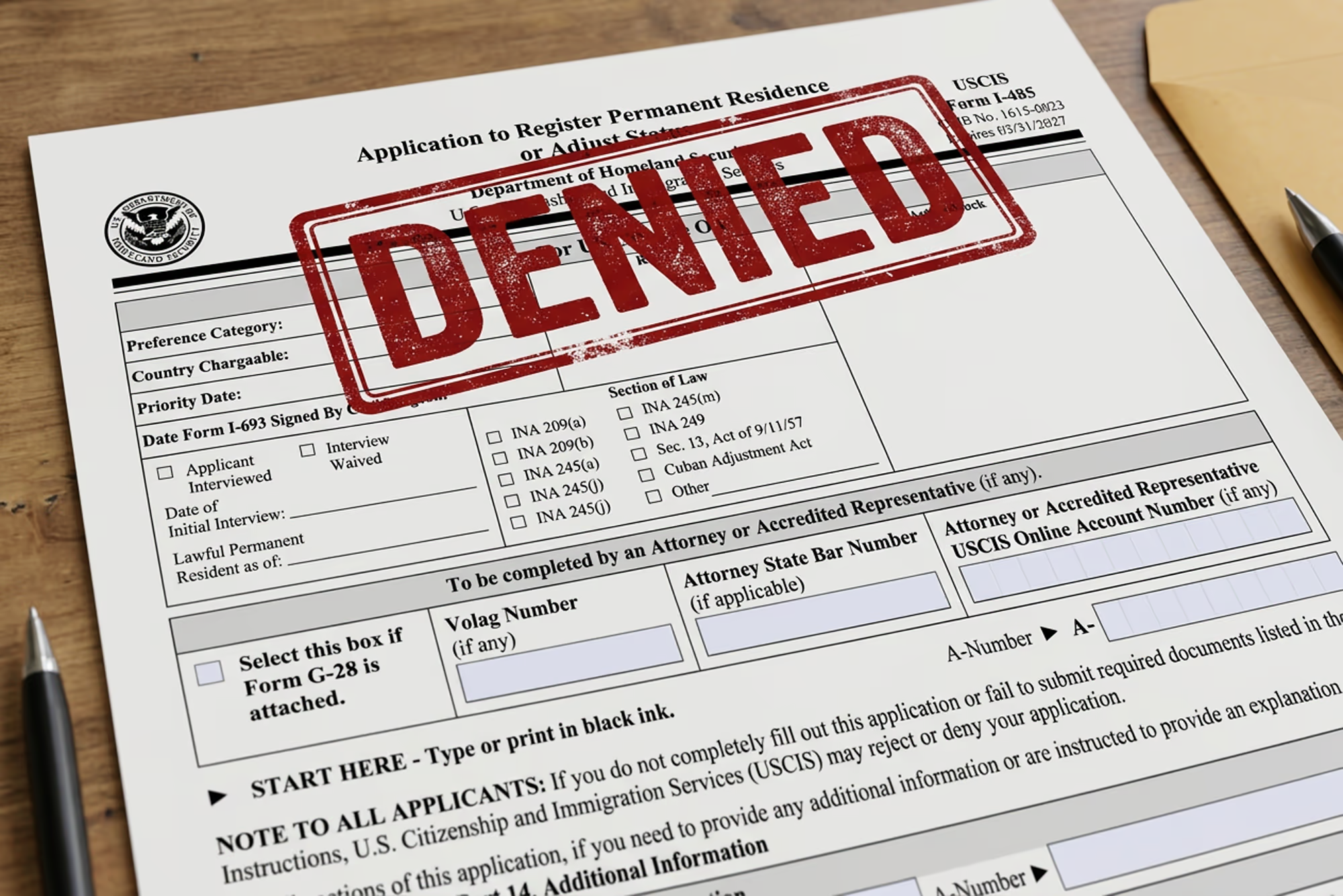
When your I-485 is denied, USCIS is now referring the case to removal proceedings if you are out of status at the time of denial. A denied I-485 now moves into proceedings before an immigration judge faster than most applicants expect. An employment authorization based on a pending adjustment of status is immediately revoked. Any advance parole based on the adjustment of status is also voided. An approved I-130 petition, however, survives the denial and retains its priority date.
The current administration has sharply reduced Requests for Evidence and tightened enforcement across every stage of the I-485 process — meaning denials are arriving faster, with fewer warnings, and with more immediate consequences than applicants expect. Anyone with a pending or recently denied application needs to understand the new reality.
What You’ll Learn
- Whether a denied I-485 automatically puts you in removal proceedings and the one exception that changes the answer
- Why your employment authorization card is void the moment your I-485 is denied, and what USCIS now requires you to do with it
- What happens to your approved I-130 petition after an I-485 denial, and how to preserve your priority date
- Why departing the U.S. on advance parole is now far more dangerous than it was even a year ago
- What administrative remedies exist after a denial, including the immigration court pathway and its new costs
- How unlawful presence accrues after a denial and why days you accrued before filing still count
I-485 Denied: Does That Mean You Get Deported?
A denied I-485 — the application to adjust your status to lawful permanent resident — does not automatically mean you will be sent back, as the law mandates that an immigration judge must enter an order of removal before a deportation occurs in most cases.
If USCIS denies your I-485 and you are out of status at the moment of denial, the agency will refer your case to immigration court by issuing a Notice to Appear, which formally commences removal proceedings against you.
There is one meaningful exception. If you were in valid status prior to and up until the denial (an H-1B, for example), you remain in status, and USCIS cannot place you into removal proceedings. The key variable is your status at the exact moment the denial is entered, not when you filed.
That distinction matters more now than it used to. USCIS has sharply reduced how often it issues Requests for Evidence (RFEs) — the notices that once gave applicants a chance to fix gaps in their filing. If the agency finds an application insufficient today, it may enter a denial outright.
A spousal petition that previously might have been processed through to an interview without initial complete documentation may now be denied if documentation is missing or inaccurate at filing.
Once a case enters removal proceedings, the stakes change: the same application is now decided by a judge who can also order you removed. Errors that might have been correctable before become much harder to remedy.
Key Insight: USCIS is now denying applications outright rather than issuing Requests for Evidence. If your case is not filed in approvable condition from day one, the denial and the removal proceedings that follow may arrive without any warning.
Your Work Permit Is Void the Day Your I-485 Is Denied
The printed expiration date on your EAD (Employment Authorization Document) does not protect you after what happens if adjustment of status is denied. That date only matters while the I-485 it was issued for remains pending.
An EAD tied to a pending I-485 has always been void the moment that application is denied — the expiration date on the card is irrelevant. What is new is enforcement. USCIS is now actively tracking these cards and requiring applicants to physically return them to the government.
The Bottom Line: An EAD tied to a pending I-485 has always been void upon denial, but USCIS is now actively tracking these cards and requiring applicants to physically return them to the government.

I-485 Denied: What Happens to Your Approved I-130
Your I-130 — the underlying family-based petition — and your I-485 — the application to adjust your status inside the United States — are two separate applications with different elements of proof. Denial of one does not automatically mean denial of the other.
The dependency runs in one direction only. If the I-130 is denied, the I-485 falls with it, because adjustment of status requires an underlying petition. But the reverse is not true: an I-485 denial does not revoke the I-130.
An approved I-130 survives an I-485 denial and keeps its priority date — the place in line established when the petition was first filed.
However, an important exception applies to this rule. Should your adjustment of status application be denied while you are abroad, any parole authorization linked to that application is immediately voided, potentially stripping you of the legal right to re-enter the United States.
To pursue consular processing at a U.S. embassy abroad, you must actively transfer the petition from USCIS to the Department of State. That transfer does not happen automatically.
Once transferred, if your priority date is current, the Department of State will move forward, but if you take no action on a current case within one year, the Department of State may revoke the I-130.
Key Insight: An approved I-130 survives an I-485 denial and keeps its priority date, but to pursue consular processing, you must actively transfer the petition from USCIS to the Department of State. It does not happen automatically, and an untouched current case can be revoked after one year.
Why Leaving the U.S. Is Riskier Than It Used to Be
The rules around international travel changed recently, and the change is significant, implicating whether you may be eligible to adjust status and obtain permanent residence.
A pending adjustment of status application requires you to stay in the United States unless you have been granted advance parole — a travel document that allows you to leave and return without abandoning your case. Leaving without an advance parole while an adjustment of status is pending is treated as abandonment of your permanent residence application.
Recent changes in the interpretation of travel with a parole are legally significant. Thus, even holding a validly issued advance parole document carries real danger now. The Board of Immigration Appeals just made a decision with terrible implications: departing on advance parole now triggers unlawful presence bars for time spent in the U.S. outside of status. Unlawful presence bars forbid re-entry for three or ten years depending on the amount of unlawful presence accrued. Previously, travel with a parole did not trigger unlawful presence bars. The protection against triggering unlawful presence bars used to apply to advance parole departures — it no longer does.
Once your green card is actually granted, you are free to travel internationally. Until then, consult an immigration attorney before leaving the United States regardless of what documents you hold.
The Bottom Line: A recent Board of Immigration Appeals decision now holds that departing on advance parole triggers unlawful presence bars from reentry — a protection that previously existed is gone. Do not leave the United States without consulting an immigration attorney first.

How Unlawful Presence Works After an I-485 Denial
Unlawful presence is the count of days you remain in the United States in unlawful status. Unlawful status is defined by statute and generally is the time in the United States without authorization. Time inside the United States prior to filing an adjustment of status that has accrued counts toward the three- and ten-year bars under INA § 212(a)(9)(B).
Understanding these thresholds is critical when evaluating the consequences of an adjustment of status denial.
While your I-485 is pending, the unlawful presence clock stops. The day USCIS denies the application, unlawful presence begins to accrue again.
Any unlawful presence you accrued before filing does not disappear but counts in full toward both bars the moment the denial occurs. The pending I-485 pauses further accrual; it does not reset the total.
If you entered lawfully and your total unlawful presence has remained below 180 days at the time you leave, no statutory bar blocks your return.
That said, the absence of a statutory bar is not a guarantee of re-admission. A ground of inadmissibility such as a conviction, or even an arrest under certain circumstances like petty theft, can result in refusal to allow admission or a custody determination at admission. A statutory bar triggered by a departure following a set period of unlawful presence requires a waiver to overcome.
The Burden of Proof on Your I-485 and Why It Is Harder to Meet Now
Every I-485 applicant carries the burden of proof that they are qualified for permanent residence. That has always been the law and its regulations, as set forth in the USCIS Policy Manual, Volume 7, Part B: you must establish your own admissibility by a preponderance of the evidence — meaning more likely true than not.
What has changed is how strictly officers apply that standard in practice. Adjudicators used to extend more benefit of the doubt. That discretionary leniency is largely gone.
Canadian nationals illustrate the shift clearly. Because Canadians enter without visas, they historically had no entry stamp and could submit a sworn affidavit attesting to lawful entry. Under current practice, a sworn statement alone may no longer satisfy the preponderance standard — corroborating evidence such as bus tickets or third-party testimony may now be required.
A separate denial ground applies to employment-based and preference family categories: failure to maintain status continuously after a lawful entry is a basis for denying adjustment of status. USCIS is viewing maintenance of status as having a valid status such as student status or a work-related status. An application for political asylum, for example, is not viewed as maintaining status unless the application was approved.
Immediate relatives (a spouse, parent, or minor child of a U.S. citizen) are exempt from maintaining status to be eligible for adjustment of status. They can have overstayed or worked without authorization and still adjust, provided they entered the country legally or qualify under the old INA 245(i) provision, which expired in 2001.

Public Charge Denials: The Emergency Medical Carve-Out Is No Longer a Safe Harbor
Medicaid coverage for emergency medical treatment used to sit outside public charge analysis — the review USCIS uses to determine whether an applicant is likely to become dependent on government support. That carve-out may no longer function as a safe harbor.
USCIS now examines the timeframe, cost, and nature of the care received. Extended or expensive treatment (long-term dialysis treatment for end-stage organ failure, for example) can result in a denial based on public charge grounds even when the underlying condition is actually an emergency.
Staying within a purely time-based threshold is not enough if the care is costly or ongoing. In those circumstances, USCIS can still deny the application on public charge grounds.
I-485 Denied: Your Options for Motions, Court, and What They Cost
Two administrative remedies exist after a denial: a motion to reopen (based on new evidence) or a motion to reconsider (based on a legal or factual error in the government’s decision). Both are filed on Form I-290B and must be received with the basis and filing fee within 30 days of the denial. There is no appeal under the law that can be made to the Board of Immigration Appeals or any other agency.
However, if the government places you in removal proceedings before an immigration judge, you can renew your request for permanent residence to the judge. That adjudication of the same application for permanent residence in immigration court now requires paying a new filing fee before the court, now at $2,980 (higher than the original USCIS fee).
The 30-day deadline to file Form I-290B applies regardless of where you are when the denial arrives. Adjustment of status is an inherently domestic process, and a denied I-485 legally extinguishes any parole you held while the application was pending. If you are outside the United States when your adjustment of status is denied, that parole is gone and, with it, your right to re-enter.
Key Insight: Applicants placed in removal proceedings can renew their I-485 before an immigration judge, but this now requires paying a new filing fee, now at $2,980, but subject to inflationary adjustments.
Frequently Asked Questions
Do I get deported if my green card application is denied?
An I-485 denied by USCIS doesn’t automatically mean deportation. You will be placed in removal proceedings if you are out of status when USCIS denies your application; your case will be referred to removal proceedings. The exception is if you hold a valid, status-conferring petition like an H-1B at the moment of denial; you remain in status and cannot be placed into proceedings. In removal proceedings, you are appearing before a judge with a government attorney cross-examining you as opposed to an immigration officer.
How long can I stay in the U.S. after my I-485 is denied?
After your I-485 is denied, unlawful presence begins accruing again from the date of denial. You can remain in the United States to fight for your right to adjustment, either through a properly filed I-290B or in removal proceedings.
What happens to my I-130 if my I-485 is denied?
An I-130 and I-485 are two separate applications with different burdens of proof. Denial of the I-485 does not impact a valid and approvable or approved I-130. If, however, the I-130 is denied, the I-485 will be denied.
To pursue consular processing after an I-485 denial, you must transfer the I-130 petition from USCIS to the Department of State. If your priority date is current but you take no action within one year, the Department of State may move to revoke the I-130.
Can I still use my work permit after my I-485 is denied?
No. If your I-485 is denied, your Employment Authorization Document (EAD) becomes void, and this has always been the law. An EAD tied to a pending I-485 has never been valid beyond that application. What has changed in 2026 is enforcement: USCIS is now actively tracking these cases and requiring applicants to physically return the EAD card to the government.
What are the most common reasons an I-485 gets denied?
The most common denial grounds today fall into three areas.
Failure to maintain status applies to employment-based and preference family categories (not immediate relatives) and is being enforced more rigorously than before.
Insufficient upfront evidence is now a direct denial risk. USCIS is issuing far fewer Requests for Evidence and will deny outright without giving applicants a chance to fix deficiencies.
Public charge findings are expanding. Even emergency Medicaid use (such as dialysis) can now trigger denial.
Can I appeal an I-485 denial?
You cannot appeal an I-485 denial to the BIA or any other agency. Your two administrative options are a motion to reopen (based on new evidence) or a motion to reconsider (based on government error), both filed on Form I-290B within 30 days. A third pathway exists: if placed in removal proceedings, you can renew your green card request before an immigration judge, but this now requires a new filing fee estimated at over $2,980, higher than the initial adjustment fee to USCIS.
Is it safe to travel outside the U.S. while my I-485 is pending or after it is denied?
Traveling while your I-485 is pending is risky. Leaving without advance parole is treated as abandonment of your application. Even with advance parole, a recent Board of Immigration Appeals decision now holds that departure triggers unlawful presence — a bar that previously did not apply. Unlawful presence can trigger inadmissibility bars lasting years or decades. Advance parole also now requires an additional $1,000 fee. Consult counsel before leaving the U.S. for any reason while your case is pending.
What to Do Next
This week:
- If you have an I-485 denied in the last few weeks, confirm immediately whether you are currently in a valid immigration status — this determines whether removal proceedings are triggered.
- Stop using your EAD. An EAD tied to an I-485 denied by USCIS is void, and the agency is now requiring the physical card to be returned.
This month:
- If you want to file a motion to reopen or reconsider, the deadline is 30 days from the denial date. Gather new evidence or identify the legal error before that window closes.
- If you have an approved I-130 and want to pursue consular processing, initiate the transfer of your petition from USCIS to the Department of State. Do not let a current priority date sit untouched — the Department of State can move to revoke after one year of inaction.
- If you are outside the United States and your I-485 was denied, consult an attorney before attempting to re-enter. The parole tied to your pending application is legally extinguished by the denial.
Ongoing:
- Do not depart the United States without advance parole if your I-485 is still pending. Departure without it is treated as abandonment of the application.
- Even with advance parole in hand, consult counsel before any international travel. A recent BIA decision now holds that departure on advance parole triggers unlawful presence.
- Track your unlawful presence carefully. Days accrued before your I-485 was filed are not erased by the pending application — they count in full toward the three-year and ten-year bars if you eventually depart.
Require Legal Guidance for Your I-485 Application?
If you or a loved one are affected by the travel ban or other immigration restrictions, contact our team.
This article is provided for informational purposes only, and does not constitute legal advice nor does it create an attorney–client relationship with Oltarsh & Associates, P.C. or any of its lawyers, employees and/or agents. Laws and policies change, and information here may not reflect the most current legal developments. You can contact us about your specific situation.




 English
  Español